
Portugal
Beyond the Beach: 7-Day Itineraries for Madeira and the Azores (2026)
Plan the perfect Madeira Azores itinerary with our complete 7, 10, and 14-day guides. Discover volcanic landscapes, levada hikes, whale watching, and hidden gems across both Atlantic archipelagos.

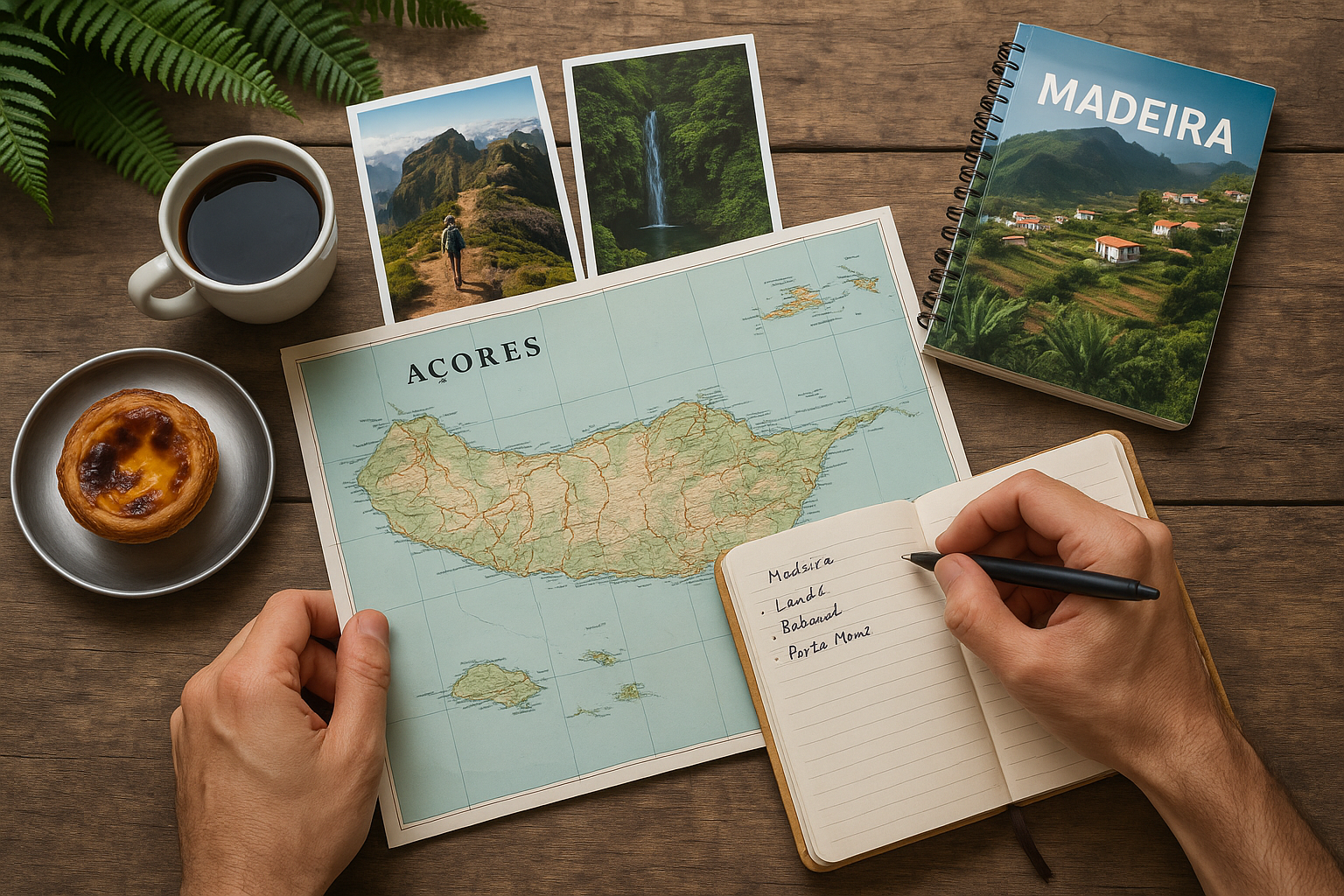
Your Complete Madeira Azores Itinerary for 7, 10, and 14 Days of Real Adventure
If you’re building a Madeira Azores itinerary and you’re tired of the same recycled advice, you’re in the right place. These two Portuguese archipelagos sit in the middle of the Atlantic Ocean, and they couldn’t be more different from each other — or from anywhere else you’ve probably traveled. One is a lush, vertical island covered in ancient laurel forests and carved irrigation channels. The other is a scattered collection of nine volcanic islands where crater lakes glow turquoise and the ocean smells like sulfur in the best possible way. Both are extraordinary. Both deserve more than a beach holiday. And both reward the kind of traveler who actually wants to feel something.
This guide gives you two complete 7-day itineraries — one for Madeira, one for the Azores — plus a clear plan for combining both into a 10- or 14-day trip. Built around real experiences, practical logistics, and the kind of moments you’ll still be talking about years from now. No filler. No fluff. Just the good stuff.
Why a Madeira and Azores Itinerary Makes So Much Sense Right Now
Both Madeira and the Azores have been quietly gaining attention among younger travelers for a few years now. That momentum hasn’t slowed down — but the islands haven’t sold out either. You’ll find crowds at the most famous viewpoints, sure, but step ten minutes off the main trail and you’re completely alone with the landscape.
Madeira sits about 1,000 kilometers southwest of Lisbon and just over 600 kilometers west of Morocco. The Azores are further out — roughly 1,500 kilometers west of mainland Portugal, scattered across the Atlantic in three groups. Flights from Lisbon take about 90 minutes to Madeira and around two hours to São Miguel in the Azores. From London, Amsterdam, or Frankfurt, you’re looking at direct connections that rarely exceed three hours. For European travelers especially, the effort-to-reward ratio here is genuinely hard to beat.
What makes both destinations stand out right now is the combination of dramatic natural scenery, a growing food culture rooted in local ingredients, and a travel community that’s starting to understand that the real experience happens away from the postcard spots.
Still deciding whether to visit one or both? Here’s the short version:
- Choose Madeira if you want dramatic hiking, a compact island you can explore thoroughly in a week, and a vibrant capital with great food.
- Choose the Azores if you want volcanic landscapes, whale watching, island hopping, and a wilder, more remote feel.
- Do both if you have 10 to 14 days and want one of the most varied Atlantic adventures possible.
7-Day Madeira Itinerary: Levadas, Cliffs, and Slow Mornings
Madeira is compact enough to explore thoroughly in a week — but rich enough that you’ll leave wanting more. This 7-day Madeira itinerary balances iconic hikes with quieter discoveries, giving you a genuine feel for the island rather than just its highlights reel.
Day 1 – Arrive in Funchal, Eat Well, Sleep Better
Land at Cristiano Ronaldo International Airport — yes, that’s its real name — and make your way into Funchal, the island’s capital. Don’t try to do too much on arrival day. Drop your bags, walk down to the Mercado dos Lavradores, and let the city come to you. The covered market is alive with vendors selling passion fruit, custard apples, and flowers that look almost too vivid to be real. Grab a bica (espresso) at a counter inside and watch how the locals move through the space.
For dinner, look for a family-run tasca in the old town rather than the tourist-facing restaurants along the waterfront. Ask for espada com banana — black scabbardfish served with fried banana and passion fruit sauce. It sounds unusual. It tastes like the island put itself on a plate.
Day 2 – Levada do Caldeirão Verde
This is one of Madeira’s most rewarding hikes and a perfect introduction to the levada network. Levadas are narrow stone irrigation channels that carry water from the wet north to the drier south of the island — and they’ve been doing it since the 15th century. The trails that run alongside them cut through the heart of the island’s ancient laurisilva forest, a UNESCO-listed ecosystem that’s been largely unchanged for millions of years.
The Caldeirão Verde trail starts at Queimadas and takes about four hours return. You’ll walk through tunnels carved into the rock, emerge onto clifftop paths with views down into green ravines, and eventually reach a waterfall dropping into a small pool surrounded by moss and ferns. Bring a headlamp for the tunnels, wear layers, and start early to avoid the midday heat. The trail is well-marked but can be slippery after rain.
Day 3 – Pico do Arieiro and the Ridge Walk
Wake up before dawn. Seriously. Drive up to Pico do Arieiro — Madeira’s third-highest peak at 1,818 meters — and watch the sunrise from above the clouds. The island disappears below a white sea and the peaks of Pico Ruivo and the surrounding ridges catch the first light in shades of orange and pink. It’s one of those mornings that resets something in you.
If you’re comfortable with exposed ridges and don’t mind some scrambling, the trail from Pico do Arieiro to Pico Ruivo is one of the best hikes in the entire Atlantic. It takes around three to four hours one way and involves tunnels, narrow paths, and views that make the effort feel almost unfair in the best sense. You can arrange a taxi back from Pico Ruivo or walk down to Achada do Teixeira and get picked up there.
Day 4 – North Coast Villages and Porto Moniz
Rent a car or join a small group tour and head north. The ER101 coastal road between São Vicente and Porto Moniz is one of the most dramatic drives in Europe — tunnels cut through black basalt cliffs, the Atlantic crashes against the rocks below, and the villages clinging to the hillsides look like they’ve been there forever. Stop at São Vicente for coffee and a walk through the narrow streets. Continue to Porto Moniz for lunch near the natural lava pools, where locals swim in clear Atlantic water enclosed by ancient volcanic rock.
👉 Read also: 7 Days in Madeira: A Local's Itinerary Beyond the Guidebook (2026)
Day 5 – Slow Day in Funchal’s Old Town
Give yourself a day without a plan. Wander the Zona Velha, Funchal’s old quarter, where the street art is some of the best you’ll see anywhere in Portugal. Visit the Blandy’s Wine Lodge for a tasting of Madeira wine — a fortified wine that’s been produced on the island for centuries and tastes nothing like what you’d expect. In the afternoon, take the cable car up to Monte and walk back down through the botanical gardens.
Day 6 – Fanal Forest and the West
The Fanal plateau in the Paul da Serra highlands is where Madeira gets genuinely otherworldly. Ancient til trees, some over 500 years old, grow in twisted shapes through the mist. On a foggy morning, the place feels like something from a film set — but completely real. The hike through Fanal is relatively gentle and takes about two hours. Combine it with a drive through the western villages of Paúl do Mar and Jardim do Mar, where the surfing culture is quiet and local and the cliffs drop straight into the ocean.
Day 7 – Final Morning, Final Meal
Before your flight, take one last walk along the Funchal seafront. Grab a poncha — the island’s traditional sugarcane spirit mixed with honey and lemon — at a bar that’s been serving it the same way for decades. Pack a bag of bolo do caco (the island’s flat bread made with sweet potato) for the journey home. You’ll want something to remember the taste of this place.
7-Day Azores Itinerary: Volcanoes, Whales, and Island Hopping
A well-planned Azores itinerary usually focuses on São Miguel — the largest and most accessible island — with optional day trips or short flights to neighboring islands. This itinerary is built around São Miguel with one overnight on Faial, giving you a genuine sense of how different each island feels.
Day 1 – Arrive in Ponta Delgada, São Miguel
São Miguel’s capital is small, walkable, and genuinely charming. The black and white cobblestone streets, the blue-trimmed churches, and the harbor lined with fishing boats make it feel both historic and alive. Spend your first evening exploring on foot. Eat at a local restaurant and order alcatra if you can find it, or stick to the island’s excellent tuna — caught fresh from the surrounding Atlantic and prepared simply with local herbs and olive oil.
Day 2 – Sete Cidades and the Twin Lakes
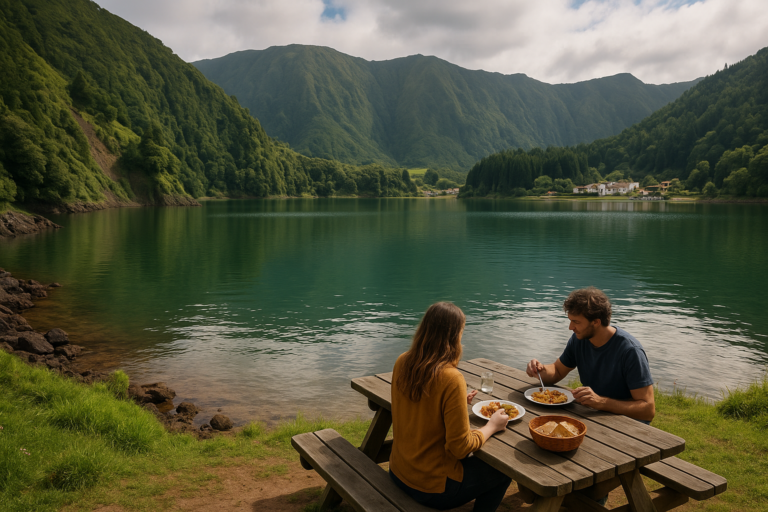
This is the image that defines São Miguel for most people — two crater lakes, one blue, one green, separated by a narrow bridge in the collapsed caldera of an ancient volcano. The science behind the color difference is still debated (light reflection, mineral content, and algae all play a role), but standing at the Vista do Rei viewpoint and looking down at both lakes simultaneously, the explanation feels almost beside the point. You can hike the rim of the caldera in about four hours, or rent a kayak and paddle across the lakes themselves. Both are worth it.
Day 3 – Furnas Valley: Hot Springs and Local Stew
Furnas is where the Azores reminds you that you’re standing on an active volcano. The valley floor bubbles and steams from dozens of fumaroles and hot springs. You can bathe in the thermal pools at Terra Nostra Park — a botanical garden built around a warm iron-rich pool that stains your skin orange if you stay in long enough. For lunch, order cozido das Furnas: a hearty meat and vegetable stew that’s been slow-cooked underground in volcanic heat for six hours. It’s one of the most genuinely local food experiences in the entire Atlantic.
Day 4 – Whale Watching and Nordeste
The Azores sits in one of the most important whale migration corridors in the world. Between April and October, sperm whales are resident in the waters around São Miguel, and humpbacks, blue whales, and dolphins pass through regularly. Visit Azores’ official whale watching guide lists certified operators who follow strict wildlife protection protocols — worth checking before you book. A half-day trip usually guarantees at least one sighting.
In the afternoon, drive to Nordeste, the wild northeastern tip of São Miguel. The landscape here is steeper, greener, and less visited than the rest of the island. The viewpoints at Ponta do Sossego and Ponta da Madrugada look out over cliffs and ocean with no crowds and no noise except the wind.
Day 5 – Fly to Faial: The Blue Island
SATA Air Azores runs inter-island flights that take under an hour and cost surprisingly little if you book in advance. Faial is known as the Blue Island because of the hydrangeas that line every road and field from June through September. The island’s western tip is home to the Capelinhos volcano, which erupted in 1957 and added a new peninsula of black lava to the coastline. Walking across that lava field, with the old lighthouse half-buried in ash, is one of those experiences that stays with you. The Visit Portugal Azores page has solid background on the geological history if you want context before you go.
Day 6 – Horta Marina and Pico’s Silhouette
Faial’s main town, Horta, has one of the most storied marinas in the Atlantic. Sailors crossing from Europe to the Americas have been stopping here for centuries, and the tradition of painting your boat’s insignia on the marina walls has created a living mosaic that covers every surface. Walk the length of it slowly — you’ll find flags, names, dates, and stories from every corner of the world.
On a clear day (and many days are clear in summer), you can see Pico Island from Horta’s waterfront. The volcanic cone of Mount Pico rises 2,351 meters straight out of the ocean — the highest point in Portugal — and its silhouette against the late afternoon sky is the kind of view that makes you want to come back with more time.
Day 7 – Return to São Miguel, Reflect
Fly back to São Miguel for your onward connection. If you have a few hours before your flight, spend them at Lagoa do Fogo — the Fire Lake — a remote crater lake in the center of the island that’s accessible only by foot or 4×4. The hike down takes about 45 minutes and the lake at the bottom is cold, clear, and completely surrounded by volcanic rock and endemic vegetation. It’s the kind of place that feels like it belongs to no one and everyone at the same time.
How to Combine Madeira and the Azores in One Trip
Plenty of travelers want to experience both archipelagos on a single journey — and it’s absolutely doable if you plan it right. Here’s how to make a combined Madeira and Azores itinerary work without feeling rushed.
The 10-Day Option
Five nights in Madeira, five in the Azores. You’ll feel the time pressure on both ends, but you’ll get a genuine taste of each. Prioritize the Caldeirão Verde levada and the Arieiro ridge walk in Madeira, then Sete Cidades, Furnas, and whale watching in São Miguel. Skip the Faial overnight and save it for a return trip.
👉 Read also: Madeira 2026: 7-Day Itinerary with Local Insights
The 14-Day Sweet Spot
This is the version that actually lets you breathe. Seven nights in Madeira, seven in the Azores. Follow both full itineraries above and you’ll leave each island feeling like you actually got to know it. This is the format we’d recommend to anyone who can swing the time off.
Logistics: Getting Between the Two
There’s no direct ferry between Madeira and the Azores — you’ll need to fly. The most common route is Madeira to Lisbon, then Lisbon to São Miguel. TAP Air Portugal and Azores Airlines both operate this connection. Total travel time is usually around four to five hours including the layover. Book both legs together when possible to protect yourself if the first flight is delayed.
Alternatively, some travelers fly into one archipelago from their home country and out of the other — a one-way routing that works well if you’re coming from the UK, Germany, or the Netherlands, where direct connections to both Madeira and the Azores exist.
Practical Tips for Your Madeira Azores Itinerary
Best Time to Visit
- Madeira: Year-round destination, but spring (March–May) is exceptional for flowers and waterfalls. Summer is busier and drier. Winter is mild and quieter.
- Azores: May through October for whale watching and hiking. July and August are the warmest months but also the most crowded. Shoulder season (May–June, September–October) offers the best balance.
Getting Around
- In Madeira, renting a car gives you the most freedom, especially for the north coast and highlands. Roads can be steep and narrow — drive carefully.
- In the Azores, São Miguel is manageable with a rental car. Inter-island travel is easiest by SATA flights, though ferries run between the central group islands in summer.
Budget Considerations
- Both destinations are more affordable than most Western European alternatives, especially for food and accommodation.
- Book flights early — Azores inter-island fares and Madeira connections from northern Europe sell out during peak summer weeks.
- Hiking is free. Most levada trails and volcanic crater walks cost nothing beyond your transport to the trailhead.
What to Pack
- Waterproof jacket (Madeira’s north side and the Azores highlands can change weather in minutes)
- Sturdy hiking shoes with grip
- Headlamp for levada tunnel sections
- Swimwear for thermal pools and lava rock swimming spots
- A reusable water bottle — both islands have clean tap water
Madeira vs Azores: How to Choose (or Why You Should Do Both)
This is the question most people ask when they start planning a Madeira Azores itinerary — and the honest answer is that they’re solving for different things.
Madeira is more compact, more dramatic in a vertical sense, and easier to cover thoroughly in seven days. The levada network alone could keep a hiker busy for two weeks, but you can hit the essential trails without feeling like you’re rushing. Funchal is a proper city with great food, nightlife, and culture. The island suits travelers who want structure alongside adventure.
The Azores are wilder, more spread out, and more unpredictable — in the best way. Each island has its own personality. São Miguel is lush and volcanic. Faial is windswept and maritime. Pico is raw and elemental. If you love the idea of island hopping, waking up somewhere that feels genuinely remote, and not knowing exactly what the day will bring, the Azores will feel like home.
If you only have one week, choose based on what you want most. If you have two weeks, do both. Either way, you won’t feel like you chose wrong.
The Real Reason These Islands Are Worth the Journey
What both islands share is a quality that’s increasingly rare in popular destinations: they still feel like real places. The people who live there haven’t been replaced by souvenir shops and Instagram setups. The food still comes from the land and the sea. The trails still lead somewhere that feels genuinely undiscovered.
A thoughtful Madeira Azores itinerary isn’t just a travel plan — it’s an invitation to slow down, pay attention, and experience something that goes much deeper than a beach holiday ever could. These islands have been waiting in the middle of the Atlantic for a long time. They’re worth the journey.
Frequently Asked Questions
Can I visit both Madeira and the Azores in one trip?
Yes — but give yourself at least 10 days, ideally 14. Both archipelagos reward slow travel, and rushing between them means shortchanging both. The most practical route is to fly between them via Lisbon. Some travelers also fly into one and out of the other, which works well if you’re coming from the UK or northern Europe where direct connections to both exist.
Which is better for hiking — Madeira or the Azores?
Both are outstanding, but in different ways. Madeira’s levada network is unique in the world — long, accessible trails through ancient forest that follow centuries-old irrigation channels. The Azores offers volcanic crater hikes, caldera rim walks, and the ascent of Mount Pico, the highest point in Portugal. If you’re choosing purely for hiking, Madeira edges ahead for variety and accessibility. If you want raw volcanic drama, the Azores wins.
How many days do I need for a Madeira Azores itinerary?
Seven days is the minimum for either destination on its own. For a combined Madeira and Azores itinerary, plan for at least 10 days — five nights in each. If you can stretch to 14 days, you’ll get a full week in each archipelago, which is the sweet spot for actually getting to know both places rather than just passing through.
Is it expensive to travel between Madeira and the Azores?
The connection usually involves a layover in Lisbon. TAP Air Portugal and Azores Airlines both operate the route. Costs vary depending on how far in advance you book, but it’s rarely prohibitive — especially if you treat the Lisbon stopover as a bonus few hours in a great city rather than a hassle.
Do I need to speak Portuguese to travel in Madeira or the Azores?
English is widely spoken in both destinations, especially in hotels, restaurants, and tourist areas. That said, learning a few words of Portuguese goes a long way — locals genuinely appreciate the effort, and it opens doors to more authentic interactions. A simple obrigado (thank you) or bom dia (good morning) will get you further than you’d expect.
What’s the best base for an Azores itinerary?
São Miguel is the most practical base, with the best flight connections and the widest range of accommodation. Ponta Delgada, the island’s capital, is walkable, affordable, and well-positioned for day trips across the island. If you’re island hopping, you can use São Miguel as your hub and take short SATA flights to Faial, Pico, or Terceira from there.
This article was produced with AI assistance and reviewed editorially.


Planning Your First Solo Trip: A Step-by-Step Blueprint for Unforgettable Travel

Teaching English Abroad in 2026: Top Countries, Visa Requirements & Real Salaries


