
Work & Travel
Travel Insurance for Digital Nomads and Long-Term Travelers: Faye and Nomad Citizen Explained
Compare travel insurance for digital nomads with Faye and Nomad Citizen. Learn coverage gaps, evacuation costs, and long-term policy options versus standard plans.



Why Travel Insurance for Digital Nomads Hits Different Than Standard Policies
You’ve packed your laptop, booked a one-way flight, and lined up enough remote work to keep you going for months. The world is genuinely your office. But here’s the thing nobody tells you before you land in your first country: the travel insurance your parents swear by — the one designed for a two-week holiday in Spain — was never built for you. Travel insurance for digital nomads is a completely different animal, and understanding that difference could be one of the most important things you do before you leave.
Standard travel insurance is designed around a simple idea: you leave home, something goes wrong, you get compensated, you come back. But what if you’re not coming back for a year? What if “home” is currently a co-living space in Lisbon, and next month it’ll be a guesthouse in Chiang Mai? The moment your trip stops looking like a vacation and starts looking like a lifestyle, most conventional policies quietly stop working in your favor.
This guide breaks down what actually matters when you’re choosing coverage for long-term travel, how newer companies are reshaping the space, and how to make sure you’re not left scrambling when something goes wrong — because at some point, something always does.
What Makes Long-Term Travel Insurance So Different
The Residency and Duration Problem
Most standard travel insurance policies cap coverage at a fixed number of days — often 30, 60, or 90 days per trip. If you’re planning to spend six months working from Southeast Asia or a year hopping between European cities, you’ll likely hit that ceiling fast. And once you do, you’re uninsured.
There’s also the question of residency. Digital nomad visas — which are now offered by a growing number of countries — typically grant temporary residency for anywhere from six months to two years, depending on the country, and they don’t permit you to work locally for a host-country employer. That’s a very specific legal situation, and it creates a specific insurance need: you need coverage that travels with you across borders, not coverage tied to a single destination or a single trip duration.
Specialized digital nomad insurance was created precisely for this gap. It’s designed for remote professionals who live and work abroad, covering both medical emergencies and travel-related disruptions across multiple countries over extended periods. Think of it as health insurance and travel insurance that actually kept up with the way young people are choosing to live.
The Coverage Gaps You Need to Know About
Before you pick any policy, it helps to understand where standard travel insurance tends to fall short for long-term travelers:
- Trip duration limits: Many policies won’t cover trips longer than 30–90 days without a specific long-stay add-on.
- Pre-existing conditions: Standard policies often exclude pre-existing medical conditions entirely, or only cover them under very narrow circumstances.
- Work-related equipment: Your laptop is your livelihood. Most basic travel policies treat it like a personal item and cap payouts at amounts that won’t come close to replacing a professional machine.
- Mental health coverage: An often-overlooked gap. Extended travel can be isolating, and burnout is real. Many standard policies don’t cover mental health treatment abroad.
- Medical evacuation: If you get seriously ill or injured in a country with limited medical infrastructure, getting airlifted to proper care can cost tens of thousands of dollars. Not all policies cover this, and the ones that do often have conditions attached.
- Liability coverage: If you accidentally cause damage or injury to someone else, are you covered? Many travel policies don’t include personal liability, which can be a serious problem in certain situations.
None of this is meant to scare you off the nomad life — far from it. It’s just worth going in with your eyes open so you can choose a policy that actually fits your reality.
Faye Travel Insurance: Built for the Digital Age
What Is Faye?
Faye is a travel insurance company that was founded in 2019 and began offering coverage in the United States in 2022. What sets it apart from the older, more traditional players in the space is its approach: Faye is built around an all-digital experience, which means you manage everything — from buying your policy to filing a claim — through a smartphone app. For a generation that does their banking, their healthcare, and their work entirely on a phone, that’s not a small thing.
Faye also offers telemedicine as part of its coverage, which is genuinely useful when you’re in a country where you don’t speak the language and you’re not sure whether that stomach pain needs a hospital visit or just some rest and rehydration. Being able to speak to a doctor remotely, in English, from wherever you are in the world is the kind of practical feature that makes a real difference.
What Faye Covers
Faye is particularly well-regarded for a few specific coverage areas that matter to modern travelers. It includes vacation rental coverage, which is increasingly relevant as more travelers book apartments and private homes rather than hotels. It also offers options for pet owners — useful if you’re the kind of traveler who brings a dog along for the adventure.
Beyond those standout features, Faye covers the core travel insurance basics: trip cancellation, trip interruption, travel delay, lost or delayed baggage, and emergency medical coverage. The app-based claims process is designed to be faster and more transparent than traditional insurers, where you might be waiting weeks for a response after submitting a paper form.
One thing to be aware of: Faye’s policies are primarily designed for trips rather than indefinite long-term travel. If you’re planning a specific journey of a defined length, Faye is worth a serious look. If you’re planning to be on the road indefinitely with no fixed return date, you may need to explore whether annual or multi-trip policies better suit your situation.
The App-First Experience
The digital-first model isn’t just a gimmick. When you’re abroad and something goes wrong, the last thing you want is to be on hold with a call center, trying to explain your situation across a bad international connection. Faye’s app-based approach means you can document incidents, upload receipts, and track your claim status in real time. For younger travelers who’ve grown up expecting that kind of immediacy from every digital service they use, it’s the experience they were hoping travel insurance would eventually catch up to.
You can learn more about Faye’s coverage details and how it compares to other options at U.S. News & World Report’s Faye review.
Understanding the Nomad Insurance Landscape Beyond Single Providers
Annual vs. Trip-by-Trip Policies
One of the biggest decisions you’ll make as a long-term traveler is whether to buy a single-trip policy, a multi-trip annual policy, or a dedicated nomad health insurance plan. Each has its place, and the right choice depends on how you actually travel.
If you’re taking one extended trip of a defined length — say, six months in South America — a single comprehensive policy covering that entire period might be your most straightforward option. You know the dates, you know the destinations, and you can price it accordingly.
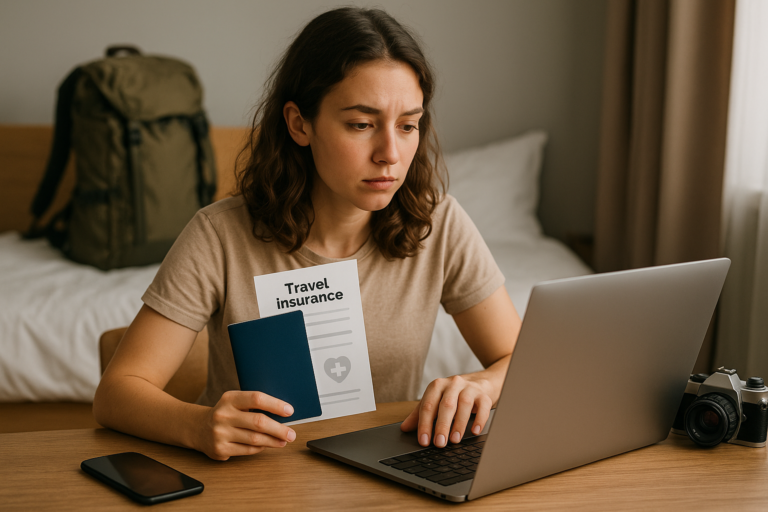
If you’re traveling in shorter bursts throughout the year — a month here, a few weeks there — an annual multi-trip policy can work out significantly more cost-effective than buying individual policies each time. You pay once and you’re covered for every trip you take within a twelve-month window, usually up to a maximum number of days per trip.
If you’re living abroad more or less continuously with no fixed return date, you’re probably looking at dedicated nomad health insurance — a category that functions more like international health coverage than traditional travel insurance. These plans are designed specifically for people whose lives don’t fit the “leave home, come back” model.
Health and Medical Evacuation: The Non-Negotiables
According to widely cited guidance across the nomad insurance space, travel health insurance is the single most essential type of coverage for digital nomads and long-term travelers. Everything else is secondary.
Here’s why: a broken laptop is expensive but survivable. A serious illness or injury abroad, without adequate coverage, can be financially devastating. Medical costs in some countries are surprisingly affordable, but in others — particularly if you need specialist care, surgery, or an emergency evacuation — they can run into figures that would wipe out years of savings.
Medical evacuation coverage deserves special attention. If you’re working from a remote location or a country with limited healthcare infrastructure, evacuation to a facility with proper care can cost an enormous amount. Make sure any policy you consider explicitly covers emergency evacuation and that the coverage limit is high enough to actually be useful.
Equipment and Liability: The Overlooked Essentials
Your laptop, camera, and other work equipment are tools of your trade. When you’re evaluating policies, look carefully at what’s covered under “electronics” or “personal belongings” and what the payout limits are. Many standard policies cap electronics claims at amounts that won’t get you close to replacing a professional-grade machine. Some nomad-specific policies offer higher limits or allow you to add extra coverage for equipment.
Personal liability coverage is another area worth checking. If you accidentally cause damage to a rental property or injure someone, liability coverage means you’re not personally on the hook for potentially significant costs. It’s not the most exciting thing to think about, but it’s the kind of protection you’ll be very grateful for if you ever need it.
How to Actually Choose the Right Policy
Ask the Right Questions Before You Buy
Before committing to any policy, work through these questions honestly:
- How long will you actually be traveling? Is there a fixed end date or are you open-ended?
- Which countries will you be in? Some policies exclude certain regions or have different coverage tiers by destination.
- Do you have any pre-existing medical conditions? If so, you need to find a policy that covers them or at least understand exactly what’s excluded.
- What’s your most expensive piece of equipment? Make sure the electronics coverage limit reflects reality.
- Are you working remotely? Some policies have clauses about what counts as “work” and may not cover incidents that occur while you’re actively working.
- Does the policy include 24/7 emergency assistance? When something goes wrong at 3am in a country you’ve never been to before, you want a number you can actually call.
Read the Fine Print — Seriously
It’s not the most thrilling advice, but it’s the most important. The exclusions section of any insurance policy is where the real story lives. Look for exclusions related to adventure activities if you’re planning to surf, dive, ski, or hike. Look for exclusions related to alcohol or drug use. Look for the definition of “pre-existing condition” — different insurers define this differently, and it matters.
The NerdWallet guide to travel insurance options for digital nomads is a solid resource for comparing how different types of policies handle these common exclusions and what to look for when reading the details.
Don’t Assume Your Home Country Coverage Travels With You
This is a mistake a lot of first-time long-term travelers make. Your national health insurance, your employer’s health plan, or your credit card’s travel protection might offer some coverage abroad — but it’s almost certainly not enough for extended international travel, and it may not cover you at all once you’ve been outside your home country for a certain number of days. Check the specifics before you assume you’re protected.
The Mindset Shift: Insurance as Part of Your Travel Budget
There’s a tendency among younger travelers to see insurance as a grudging expense — money you’re spending on something you hope you’ll never use. Try reframing it. Good insurance is what gives you the freedom to actually explore without a background hum of anxiety. It’s what lets you say yes to the motorbike trip, the remote island, the hiking trail that’s a bit off the beaten path, because you know that if something goes sideways, you’re covered.
The nomad lifestyle is genuinely one of the most exciting ways to live and work. Waking up in a new city, building your own schedule, connecting with people from completely different backgrounds, discovering places that don’t make it onto the standard tourist trail — it’s the kind of life that changes how you see the world. The practical stuff, including insurance, is just what makes it sustainable.
Think of a solid insurance policy the same way you think about a good pair of travel shoes: you want something reliable, something that’s going to hold up through whatever you throw at it, and something you can forget about until you actually need it. When you find the right coverage, it fades into the background — and you get on with the adventure.
Making the Decision
Choosing the right travel insurance as a digital nomad comes down to knowing yourself as a traveler. How long are you going? How remote are you willing to go? What’s your risk tolerance? What would it actually cost you — financially and emotionally — if something went wrong without coverage?
Companies like Faye are genuinely changing what the insurance experience looks like for a younger, more digitally native generation of travelers. Their app-first approach, telemedicine options, and modern claims process reflect a real understanding of how people in their twenties and thirties actually travel and work. For defined trips, they’re worth serious consideration. For indefinitely open-ended nomad living, you’ll want to explore dedicated international health plans alongside or instead of traditional travel insurance.
Whatever you choose, choose intentionally. Read the policy. Understand what’s covered and what isn’t. Make sure the coverage limits are realistic for the destinations you’re heading to. And then close the laptop, zip up the bag, and go — knowing that the practical side is handled and the adventure is entirely yours.
This article was produced with AI assistance and reviewed editorially.


New Zealand’s Geothermal Wonders: Rotorua & Where to Stay for Adventure & Maori Culture

Adventure Beyond the Beach: Things to Do in Jeju, South Korea & Tayrona Park, Colombia


