
Asia
Central Asia’s Silk Road Cities: Samarkand, Bukhara & Almaty for First-Time Visitors
Explore three essential Central Asian cities on the historic Silk Road. Discover Samarkand’s turquoise domes, Bukhara’s desert charm, and Almaty’s mountain views with pra

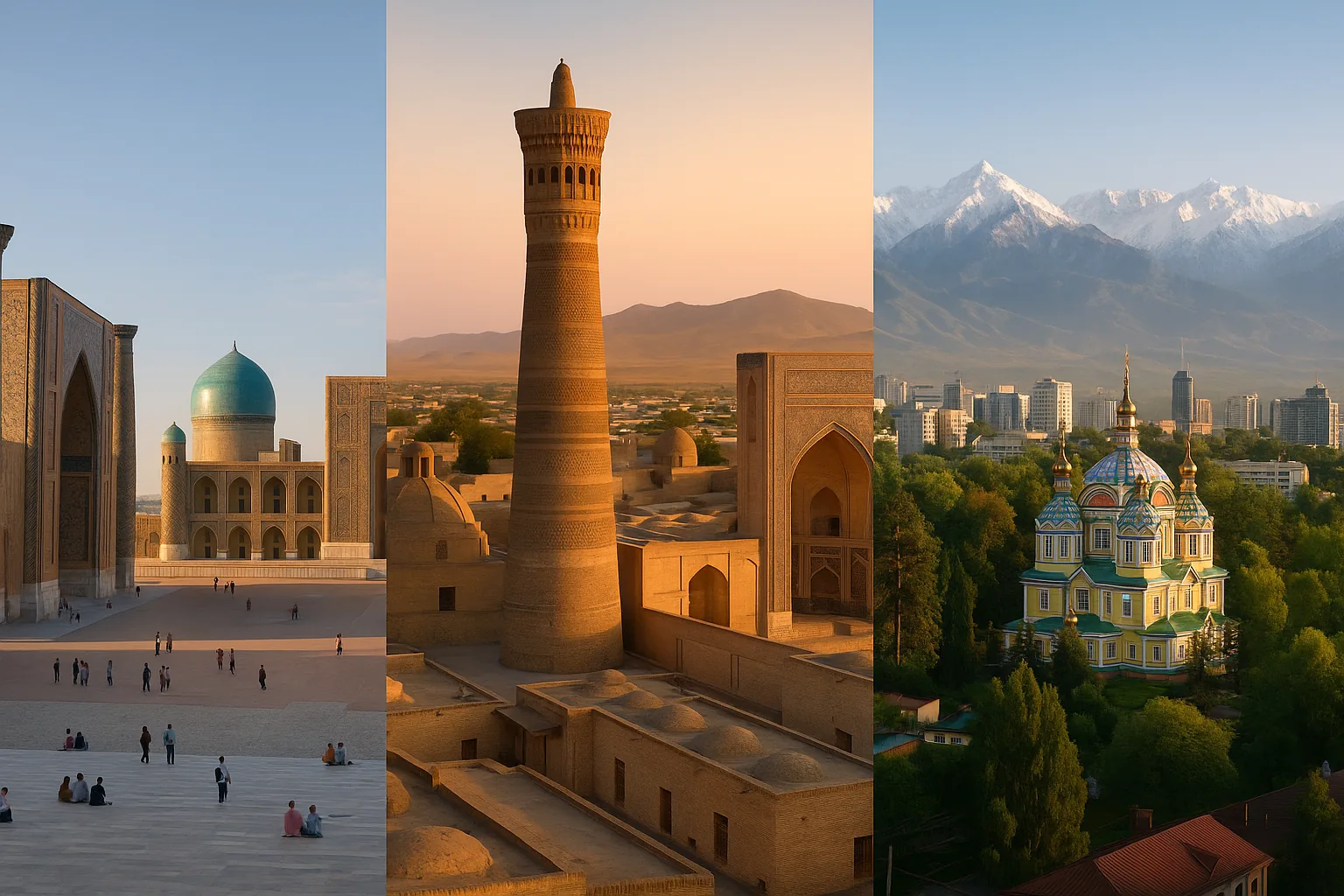
Few journeys fire the imagination quite like central Asia Silk Road travel. You’re following a web of trade routes that connected China to Europe for roughly 1,600 years — from the second century BC all the way to 1450 — and the cities left behind are some of the most extraordinary on the planet. Samarkand, Bukhara, and Almaty sit at the heart of this story, and right now, they’re more accessible to independent young travelers than ever before. If you’ve been sleeping on Central Asia, it’s time to wake up.
Why Central Asia Belongs on Your Travel Radar
Central Asia is made up of five countries: Kazakhstan, Kyrgyzstan, Tajikistan, Turkmenistan, and Uzbekistan. That’s five wildly different cultures, landscapes, and histories packed into one region — and most travelers have barely scratched the surface of any of them. While Southeast Asia fills up with backpackers every season and Europe’s “hidden gems” become increasingly hard to find, Central Asia remains genuinely off the beaten path for most young Western travelers.
That’s exactly what makes it so compelling. You can stand in front of mosques and minarets that have survived centuries of conquest, eat food that doesn’t appear on any menu you’ve seen before, and have conversations with locals who are genuinely curious about you — not just your money. The Silk Road wasn’t just a trade route for spices and silk; it was a corridor of ideas, religions, languages, and art. Walking through its ancient cities, you feel that layered history in every tiled wall and dusty courtyard.
This guide focuses on three cities that together give you a powerful introduction to the region: Samarkand and Bukhara in Uzbekistan, and Almaty in Kazakhstan. Each one is distinct. Each one is worth the journey.
Samarkand: Where Empires Left Their Mark
When people picture the Silk Road, they’re often picturing Samarkand. This city has been a crossroads of civilisations for millennia, and its monuments are staggering in scale and beauty. The centrepiece is Registan Square — three monumental madrasas facing each other across an open plaza, their facades covered in intricate geometric tilework. Stand there at dusk, when the light turns golden and the crowds thin out, and it genuinely feels like you’ve stepped into another world.
But Registan is just the beginning. Bibi-Khanym Mosque, once one of the largest mosques in the Islamic world, rises dramatically at the edge of the old bazaar district. Even in its partially restored state, it’s overwhelming. The sheer ambition of its construction tells you everything about the power and wealth that flowed through this city during its peak. Nearby, the Shah-i-Zinda necropolis — sometimes called the Blue Tombs — is a narrow avenue of mausoleums covered in some of the most vivid tilework you’ll ever see. It’s quieter than Registan, more intimate, and somehow even more moving.
Don’t spend all your time at the monuments, though. Samarkand’s bazaars are alive with colour and noise — vendors selling dried fruits, spices, handwoven textiles, and fresh bread that comes out of clay ovens still steaming. Grab a non (the round, stamped Uzbek flatbread) and wander. Get lost. That’s when the city reveals itself.
Practical Notes for Samarkand
- Most major sites are walkable from the city centre, but a taxi or rideshare app can save time between distant landmarks.
- Early mornings are the best time to visit Registan — the light is beautiful and the crowds haven’t arrived yet.
- Accommodation ranges from budget guesthouses in traditional courtyard houses (hujras) to mid-range hotels near the old city. Staying in a local guesthouse gives you a much more authentic experience than a chain hotel.
- Uzbek cuisine is a highlight — try plov (rice cooked with lamb, carrots, and spices), shashlik (grilled meat skewers), and lagman (hand-pulled noodle soup).
Bukhara: Ancient, Layered, and Utterly Absorbing
If Samarkand is the grand showpiece, Bukhara is the living museum. This UNESCO-listed city has an old town that feels genuinely inhabited — people still live, work, and pray in buildings that have stood for centuries. It’s one of the best-preserved medieval cities in the world, and wandering its maze of mud-brick lanes is an experience that’s hard to replicate anywhere else on earth.
👉 Read also: Central Asia 2026: Samarkand, Bukhara & Tashkent for First-Time Visitors
The Mir-i-Arab Madrasa is one of Bukhara’s most iconic structures — an active religious school that has educated students continuously for centuries. Its turquoise domes and white-tiled facade stand across from the Kalon Mosque and minaret, forming one of the most photographed corners of the entire Silk Road. Unlike some heritage sites that feel frozen in time for tourists, this area still pulses with real life. You’ll see students, worshippers, and merchants all going about their day.
The old city layout rewards slow exploration. There are covered bazaar domes (toki) that once specialised in different trades — one for jewellers, one for hat-makers, one for money changers. Today they sell crafts and souvenirs, but the architecture is original and the atmosphere is still charged with mercantile energy. The Ark Fortress, a massive citadel that once served as the residence of Bukhara’s rulers, dominates the skyline and offers a sweeping view over the old city from its ramparts.
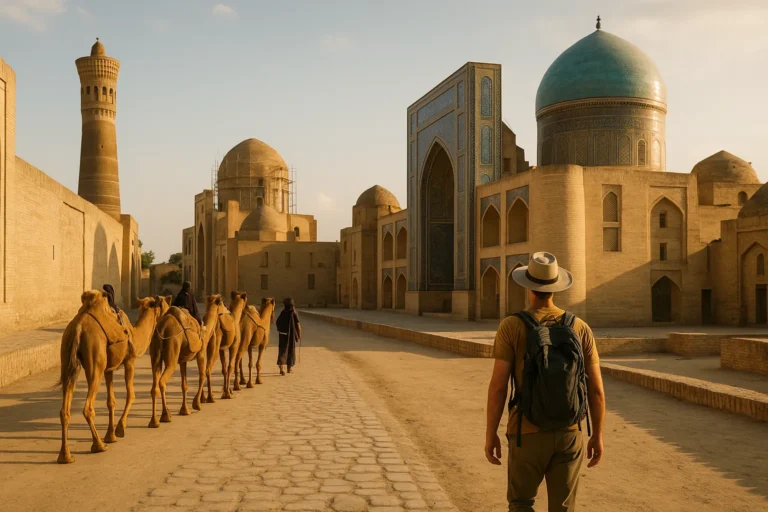
Bukhara is also the place to stay in a traditional guesthouse. Many of the city’s old merchant houses have been converted into small family-run accommodations built around central courtyards. Breakfast is usually included, and if you’re lucky, your host will tell you stories about the city that no guidebook has ever printed. These kinds of connections are what central Asia Silk Road travel is really about.
Getting Between Bukhara and Samarkand
The journey between these two cities is easier than you might expect. Travel time between Bukhara and Samarkand is approximately 1.5 hours by high-speed train — a genuinely comfortable ride that makes combining both cities in a single trip very straightforward. The train network in Uzbekistan has improved significantly, and booking tickets in advance (especially during peak season) is strongly recommended. There are also shared taxis and buses for those on tighter budgets, though journey times will be longer.
Almaty: The City That Surprises You
Almaty is Kazakhstan’s largest city and its cultural heart, and it plays a very different role in a Central Asia itinerary. While Samarkand and Bukhara immerse you in ancient history, Almaty hits you with energy, contrasts, and a cosmopolitan atmosphere that catches most first-timers off guard. This is a city of wide tree-lined boulevards, Soviet-era architecture sitting next to sleek modern buildings, and mountain peaks visible from almost every street corner.
Those mountains are the real revelation. The Tian Shan range rises dramatically to the south of the city, and within an hour of leaving the urban centre you can be hiking through alpine meadows, skiing in winter, or simply standing at a viewpoint that makes the whole city look like a miniature model below you. The Shymbulak ski resort and the Medeu outdoor skating rink are popular day trips that give you a completely different perspective on what Kazakhstan has to offer.
Back in the city, the Green Bazaar (Zelyony Bazar) is the place to spend a morning. It’s a vast covered market selling everything from smoked horse meat and fermented mare’s milk (kumiss) to mountains of dried apricots and fresh honey. It’s loud, chaotic, and completely absorbing — the kind of place where you end up buying things you didn’t know you needed. The city’s café culture is also worth exploring; Almaty has a genuinely vibrant food scene with everything from traditional Kazakh restaurants to excellent coffee shops and international cuisine.
What to Know Before You Arrive in Almaty
- Almaty is not the capital of Kazakhstan — that’s Astana — but it remains the country’s most dynamic and visited city.
- The city sits at a relatively high altitude, so give yourself a day to acclimatise before heading into the mountains.
- Public transport is affordable and functional. Taxis and rideshare apps are widely used and reasonably priced.
- English is less widely spoken than in major Western cities, but younger locals and people in the tourism industry generally manage well. Learning a few words of Russian or Kazakh goes a long way and is always appreciated.
- Almaty’s neighbourhoods each have their own character — from the leafy, gallery-filled streets near Panfilov Park to the buzzing restaurant strips further south. Walk and explore rather than planning everything in advance.
Visas, Entry, and Getting Around the Region
Visa requirements for Central Asia vary depending on your nationality and can change, so always check the National Geographic Silk Road travel guide and your government’s official travel advisory for the most current information before you book anything. As a general rule, many nationalities can now enter Uzbekistan and Kazakhstan either visa-free or with a straightforward e-visa process, but this is something you need to verify for your specific passport well in advance.
👉 Read also: Silk Road Cities for Culture Seekers: Samarkand, Bukhara & Tashkent in Uzbekistan
For getting around the region, the high-speed train between Bukhara and Samarkand is the obvious highlight. Uzbekistan’s rail network connects the main Silk Road cities efficiently. Between Uzbekistan and Kazakhstan, flying is usually the most practical option — there are regular flights connecting Tashkent (Uzbekistan’s capital) to Almaty, and journey times are short. Overland border crossings are possible but require more planning and research.
Within cities, a combination of walking, local buses, and app-based taxis covers most situations. In Samarkand and Bukhara, many of the key sites are close enough to walk between, which is honestly the best way to discover the details that make these cities so special — a carved wooden door here, a crumbling caravanserai there, a tea house tucked into an alley that you’d never find if you were rushing between landmarks in a taxi.
When to Go and How Long to Spend
The best time for central Asia Silk Road travel is spring (April to early June) or autumn (September to October). Summers in Uzbekistan can be intensely hot — temperatures regularly climb to levels that make long days of sightseeing genuinely exhausting — while winters bring cold, short days and some transport complications. Spring and autumn offer comfortable temperatures, clear skies, and the added bonus of markets full of seasonal produce.
For a first visit covering all three cities, plan for at least ten days to two weeks. That gives you three to four days in Samarkand, two to three days in Bukhara, and three to four days in Almaty, with travel days factored in. If you have more time, consider adding Tashkent (Uzbekistan’s capital, a fascinating blend of Soviet planning and Islamic architecture) or venturing into the Fergana Valley, where traditional crafts like silk weaving and pottery are still practiced in small workshops.
Don’t try to rush this region. The whole point of following the Silk Road is to slow down, absorb, and connect — with the history, with the landscapes, and with the people you meet along the way.
Honest Expectations for First-Time Visitors
Central Asia will challenge you in the best possible ways. Some things will be harder than you’re used to: navigating without much English signage, finding vegetarian food in meat-heavy culinary cultures, dealing with occasional bureaucratic quirks at borders or hotels. But these are the kinds of friction that make travel genuinely memorable rather than just comfortable.
What you’ll get in return is extraordinary. You’ll walk through cities that shaped world history. You’ll eat food that’s unlike anything you’ve had before. You’ll meet people who are warm, curious, and proud of a culture that the rest of the world is only just beginning to discover. Central Asia Silk Road travel isn’t about ticking off monuments — it’s about understanding a part of the world that has been connecting people across continents for thousands of years, and feeling, just for a moment, like part of that story yourself.
Pack light, stay curious, and give yourself permission to go somewhere that most people your age haven’t been yet. That’s exactly the kind of trip you’ll still be talking about years from now — not because it was easy, but because it was real.
This article was produced with AI assistance and reviewed editorially.


Central Asia’s Silk Road Cities: Samarkand, Bukhara & Almaty for First-Time Visitors

Bali & Lombok Itineraries: Island-Hopping for Young Travelers Who Want More Than Beaches


