
Roaming Around the World
Singapore as Southeast Asia’s Outlier: Neo-Tropical Garden City & How It Differs from Its Neighbors
Discover what makes Singapore a unique Southeast Asia destination. Explore its garden city design, cultural blend, and how it differs from Bangkok, Hanoi, and regional ne

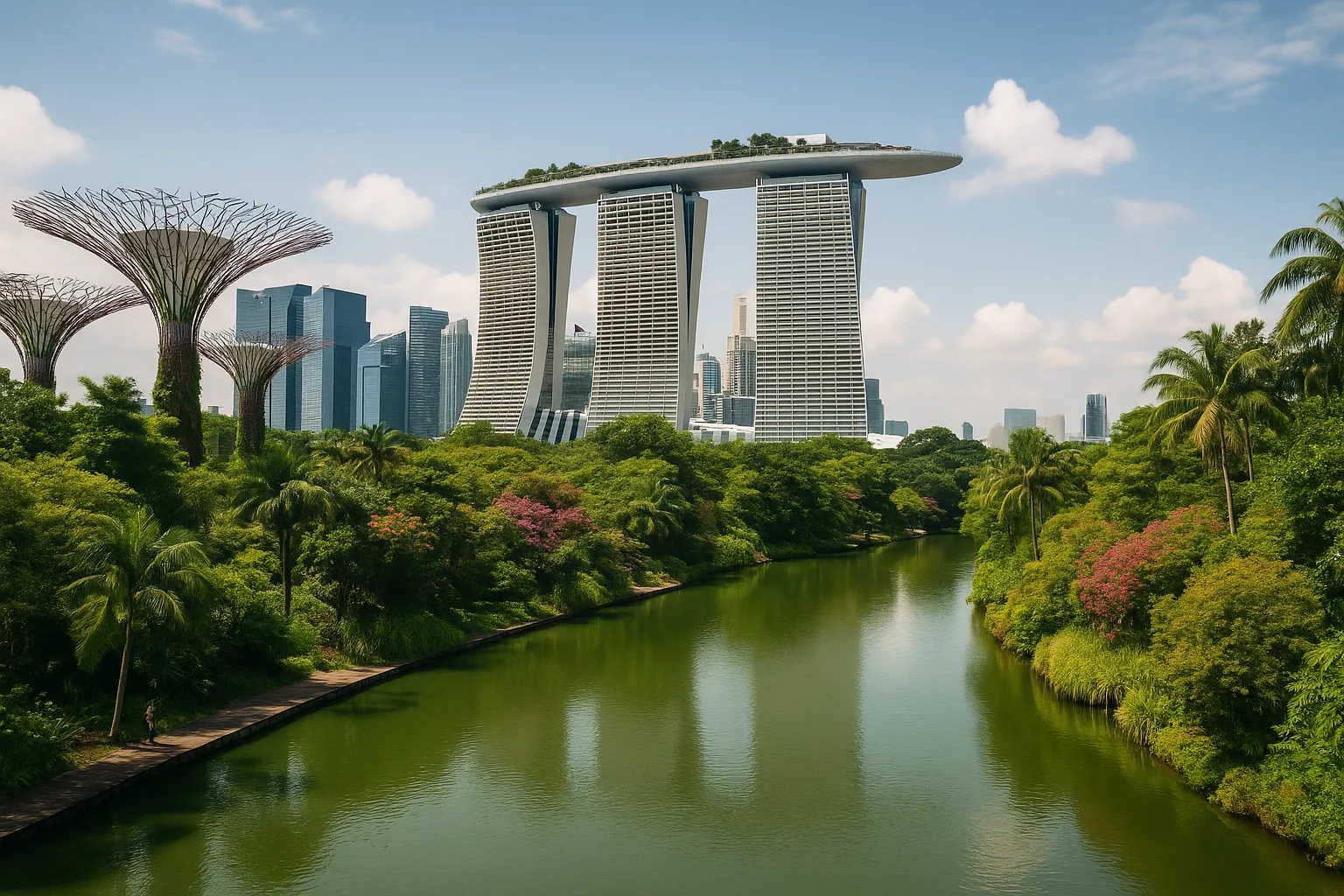
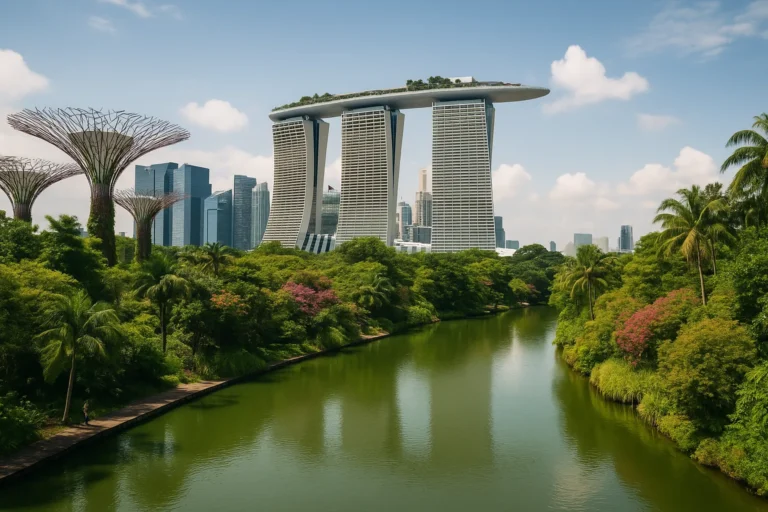
Southeast Asia has a way of pulling you in with its chaos, color, and contradictions — but Singapore sits in a category entirely its own. If you’re building out a Singapore travel guide in your head and expecting the same experience you’d get in Bangkok or Hanoi, prepare to rethink everything. This city-state is cleaner, quieter, and more organized than almost anywhere else on the continent, and that contrast is exactly what makes it so worth exploring.
Why Singapore Feels Like a Different Planet from the Rest of Southeast Asia
Most backpackers moving through Southeast Asia follow a familiar rhythm. Chaotic street markets, crumbling temples, motorbike-filled roads, and guesthouses that cost almost nothing. It’s raw, unpredictable, and genuinely exciting. Singapore is none of those things — and that’s not a criticism. It’s a completely different kind of travel experience, one that challenges the idea that Southeast Asia is a single, unified travel zone.
Where countries like Cambodia, Indonesia, Thailand, and Vietnam offer a sense of navigating the unknown, Singapore feels curated. Spotlessly clean streets, world-class public transport, functioning pedestrian crossings, and a skyline that looks like it was designed by someone who had unlimited ambition and an equally unlimited budget. The contrast isn’t subtle. It hits you the moment you step off the plane.
That said, Singapore isn’t sterile. Beneath the polished surface, there’s a genuine cultural depth that rewards curious travelers who go looking for it. The city-state is home to a mix of Chinese, Malay, Tamil, and Western influences that have been layered over decades into something truly distinct. You’re not visiting a theme park version of Asia. You’re visiting a place that has built its own identity — and done it with remarkable intention.
The Garden City Vision: Nature Woven Into the Urban Fabric
One of the first things you’ll notice in Singapore is that the greenery isn’t incidental. It’s deliberate. Singapore has long pursued what’s often described as a ‘Garden City’ vision, one that fuses nature and urban design in ways most cities haven’t even attempted. Trees line the expressways. Rooftop gardens sit above shopping malls. Vertical gardens climb the sides of office towers.
The most dramatic expression of this vision is Gardens by the Bay, the landmark park built in downtown Singapore as a living tribute to the city’s green identity. Opened to the public in 2012, it features towering Supertrees — steel structures draped in living plants that light up at night — alongside massive climate-controlled conservatories housing plants from around the world. Walking through it feels genuinely surreal, especially at dusk when the whole structure glows against the city skyline.
But Gardens by the Bay is just the headline act. Singapore’s broader commitment to integrating nature into its urban landscape means that even a walk through a residential neighborhood can feel unexpectedly lush. Parks connect to each other through green corridors. The Southern Ridges trail links several hilltop parks with elevated walkways through forest canopy. You can hike through real jungle and still be within the boundaries of one of the world’s most modern cities. That tension — between the ultra-modern and the genuinely wild — is what earns Singapore the description of a Neo-Tropical Garden Metropolis.
For young travelers who care about how cities are designed and what urban life could look like, Singapore is genuinely inspiring. It’s a working experiment in what happens when a city takes its green ambitions seriously over several decades.
How Singapore Compares to Bangkok, Saigon, and Kuala Lumpur
Spend a week in Bangkok and you’ll understand the appeal of controlled chaos. The city moves fast, eats late, and never quite lets you feel like you’ve figured it out. Ho Chi Minh City (Saigon) has that same electric energy — streets thick with motorbikes, alleys hiding incredible food, a sense that the city is constantly reinventing itself. These are places where spontaneity is almost forced upon you, and that’s a huge part of their charm.
Singapore is not that. And if you go expecting it to be, you’ll be disappointed. But if you arrive open to a different kind of experience, you’ll find a city that rewards you in completely different ways.
👉 Read also: Singapore & Kuala Lumpur: How to Navigate Southeast Asia's Modern Metropolises
The clearest differences come down to a few things:
- Organization and infrastructure: Singapore’s MRT (Mass Rapid Transit) system is one of the most reliable and user-friendly in the world. Getting from the airport to the city center is effortless. Compare that to navigating a tuk-tuk negotiation in Bangkok traffic or working out the bus system in Saigon, and the difference is stark.
- Safety: Singapore is widely considered one of the safest cities in Asia. Solo travelers — including young women traveling alone — consistently describe feeling at ease in a way that isn’t always guaranteed elsewhere in the region.
- Cost: This is where Singapore diverges most sharply. It’s significantly more expensive than Myanmar, Cambodia, Indonesia, Thailand, and Vietnam. Accommodation, food at sit-down restaurants, and activities all cost more. Budget travelers need to plan carefully and lean into the city’s genuinely affordable options — which do exist, particularly in hawker centers.
- Cultural texture: Bangkok and Saigon have a rawness that Singapore doesn’t. But Singapore’s multicultural layering — the coexistence of distinct Chinese, Malay, and Indian communities, each with their own neighborhoods, festivals, and food traditions — creates a different kind of richness that takes a little longer to appreciate.
Kuala Lumpur, just across the border in Malaysia, is perhaps the closest comparison. It shares some of Singapore’s multicultural character and modern infrastructure, but it’s more affordable and considerably more sprawling. Singapore is compact by comparison — everything feels within reach, which makes it particularly good for travelers with limited time.
Neighborhoods Worth Knowing Before You Arrive
Singapore’s neighborhoods are where the city’s real character lives. The central business district skyline is impressive, but it’s not where you want to spend most of your time. The more interesting areas are the ones that carry history and community alongside the modernity.
Chinatown is one of the most visited areas, and for good reason. The shophouses along its streets have been restored without losing their character. Temples sit between coffee shops and hawker stalls. It’s a neighborhood that feels genuinely lived-in rather than preserved for tourists, and it’s one of the better areas for affordable food and accommodation.
Little India is another essential stop — possibly the most sensory-rich neighborhood in the city. The streets are loud with color and music, the food is outstanding, and the tekka market is the kind of place you wander through without any particular agenda and end up staying for hours. It’s also one of the more affordable areas to stay, which makes it popular with budget-conscious young travelers.
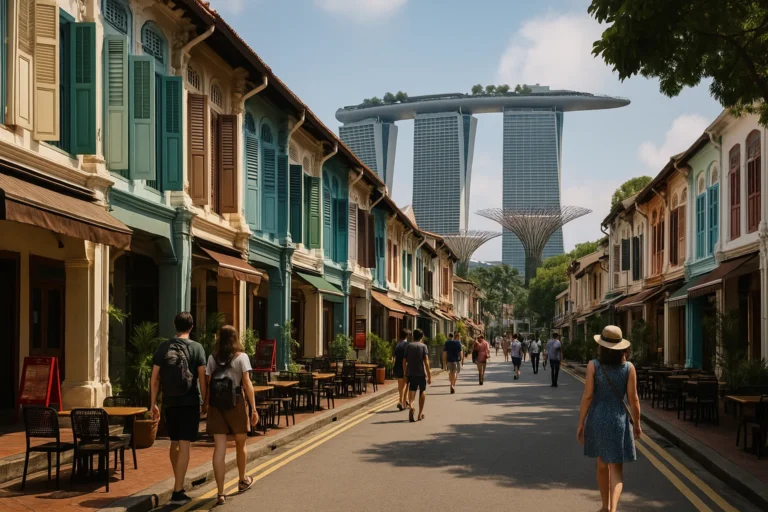
Kampong Glam is the Malay and Arab quarter, centered around the golden-domed Sultan Mosque. The surrounding streets — particularly Haji Lane — have become a hub for independent boutiques, cafés, and street art. It’s the kind of neighborhood that photographs beautifully but also genuinely rewards slow exploration on foot.
Tiong Bahru has a quieter, more residential energy. It’s known for its art deco-influenced public housing from the mid-twentieth century, its independent bookshops, and its café culture. If you want to understand what everyday Singapore life looks like for younger locals, this is a good place to spend a morning.
For travelers who want to be close to the action, Bugis sits between Little India and Kampong Glam and offers a mix of budget accommodation, street food, and easy MRT access to the rest of the city.
Eating in Singapore: The Hawker Center Culture You Need to Know
Singapore’s reputation as one of Asia’s great food cities is well earned. The diversity of the population means the food scene pulls from Chinese, Malay, Indian, Peranakan, and Western traditions — often within a single meal. But the most important thing to understand about eating in Singapore, especially if you’re watching your budget, is the hawker center.
Hawker centers are open-air food courts where individual stalls sell single dishes at prices that are genuinely affordable even by regional standards. You’ll find dishes like char kway teow (stir-fried flat rice noodles), laksa (spiced coconut noodle soup), hainanese chicken rice, and roti prata (a flaky flatbread served with curry) — all cooked to order, all at prices that make eating out feel accessible rather than extravagant.
👉 Read also: Southeast Asia City Guides 2026: Kuala Lumpur, Singapore, Vung Tau & Hat Yai for First-Time Visitors
Some of the most beloved hawker centers — like those in Maxwell Food Centre in Chinatown or the Lau Pa Sat festival market in the CBD — have been feeding locals and visitors for generations. Eating at a hawker center isn’t just a budget strategy. It’s one of the most authentic experiences Singapore offers, a place where the city’s multicultural identity shows up on a single tray.
The key rule: eat where the locals eat. If a stall has a long queue of Singaporeans at lunchtime, join it. You won’t regret it.
Budget Realities: Traveling Smart in an Expensive City
There’s no point sugarcoating it — Singapore is one of the most expensive cities in Asia. Accommodation costs more than in most neighboring countries, and if you start eating at restaurants or visiting paid attractions regularly, costs can add up quickly. But expensive doesn’t have to mean inaccessible.
The good news is that many of Singapore’s best experiences are free or low-cost. The MRT makes getting around the entire city affordable. Most of the interesting neighborhoods — Chinatown, Little India, Kampong Glam — are best explored on foot. The Southern Ridges hike costs nothing. Gardens by the Bay has free outdoor areas, including the Supertree Grove, even if the conservatories charge entry.
Staying in a well-located hostel in an area like Little India or Bugis keeps accommodation costs down while putting you close to the city’s most interesting streets. Eating at hawker centers for most meals makes a huge difference. And choosing one or two paid experiences — a rooftop bar for sunset, a visit to a museum, a cable car ride — rather than trying to do everything, keeps the trip from feeling financially stressful.
Singapore works best as a destination when you lean into what it does cheaply and well: street food, public parks, neighborhood wandering, and public transport. Trying to experience it the way you’d experience a luxury city break will drain your budget fast. Treating it as a well-organized, beautiful city with genuinely great free experiences — and supplementing those with a few splurges — makes it feel entirely worth the trip.
What Kind of Traveler Singapore Is Really For
Not every destination suits every traveler, and part of what makes a good Singapore travel guide useful is being honest about that. If you’re deep in backpacker mode — chasing the cheapest guesthouses, preferring chaos to order, and measuring a destination’s worth by how raw and unfiltered it feels — Singapore might frustrate you. It doesn’t do raw. It does refined.
But if you’re someone who values safety, efficiency, and cultural depth alongside your sense of adventure, Singapore delivers in ways that are genuinely hard to find elsewhere in the region. It’s a city that works. And for first-time travelers to Asia who might feel overwhelmed by the intensity of Bangkok or the complexity of navigating Vietnam, Singapore offers a gentler entry point — one that still feels like a genuinely foreign and fascinating place, without the friction that can sometimes come with less-organized destinations.
It’s also an excellent city for travelers who care about design, architecture, food culture, and urban planning as subjects in themselves. Singapore is a living case study in what a city can become when it’s built with intention. Walking through it with that lens makes even the everyday feel worth paying attention to.
Singapore won’t give you the chaotic, unscripted adventure that other parts of Southeast Asia offer so freely. What it gives you instead is something rarer: a city that has figured out how to be genuinely multicultural, strikingly modern, and deeply connected to its natural environment — all at once. That’s a story worth traveling to understand firsthand, and it’s one that stays with you long after you’ve left.
This article was produced with AI assistance and reviewed editorially.


Teaching English Abroad in 2026: Top Countries, Visa Requirements & Real Salaries

Where to Stay in Latin America’s Top Destinations: Buenos Aires, Bogota & Beyond


