
Asia
Hanoi in 3 Days: A Local’s Itinerary (From a Repeat Visitor)
Explore Hanoi in 3 days with an insider’s itinerary covering the Old Quarter, street food, and authentic neighborhoods. Discover why Hanoi beats other Vietnamese cities.



Hanoi is one of those cities that grabs you before you even realize what’s happening. You step off the plane, hit the streets, and suddenly you’re weaving through motorbikes, smelling pho from a cart tucked into a narrow alley, and wondering why you didn’t come sooner. A well-planned Hanoi 3 day itinerary can take you from curious first-timer to someone who genuinely understands this city — its rhythms, its layers, its contradictions. And trust us, three days is enough time to fall hard for it.
Why Hanoi Deserves More Credit Than It Gets
Hanoi doesn’t always get the spotlight it deserves. Travelers often fly into Ho Chi Minh City first, get swept up in the energy of the south, and treat Hanoi as an afterthought. That’s a mistake worth correcting. Travel writer Dustin Kemp, who has lived in Vietnam for over a decade, argues that Hanoi offers something Saigon simply can’t replicate — a slower, more layered kind of discovery that rewards the curious traveler.
With a population of around 8.6 million people, Hanoi is a genuinely large city, but it doesn’t feel overwhelming in the way some megacities do. The historic core is compact and walkable. The neighborhoods have distinct personalities. The street food scene is world-class but still rooted in daily life rather than performance for tourists. And as travel writer Emma Sturgeon puts it, Hanoi is a “you either love it or hate it” kind of city — chaotic traffic, French colonial architecture, Southeast Asian pagodas and temples, and beer averaging around 50 cents a glass. For most young travelers, that combination is irresistible.
What makes Hanoi particularly good for first-time visitors is its walkability. The Old Quarter, where most travelers base themselves, is a dense grid of streets where you can explore on foot for hours without needing a map or a plan. That kind of spontaneous wandering is exactly what travel at its best feels like.
Day One: Getting Lost in the Old Quarter
Start your first morning slowly. That’s not laziness — it’s strategy. The Old Quarter wakes up early and beautifully. Head out before 8am if you can manage it, and you’ll catch street vendors setting up, locals doing tai chi by the lake, and the city in its most honest, unperformed state.
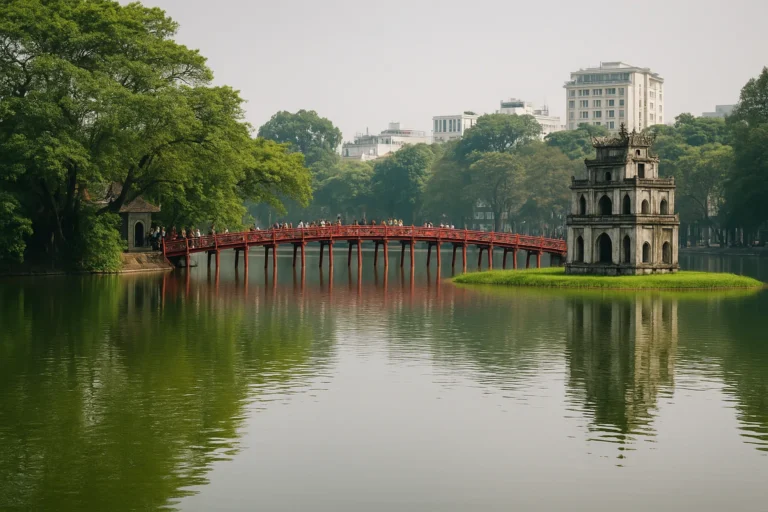
Hoan Kiem Lake is the natural starting point. Hanoi is often referred to as the city of lakes, and Hoan Kiem is the most iconic of them all. Walk the perimeter, cross the red bridge to Ngoc Son Temple on the small island, and take a moment to just sit and watch the city move around you. It costs almost nothing and sets the tone for everything that follows.
From there, push north into the Old Quarter proper. This is where the city’s historic street-by-street layout still survives — each lane traditionally dedicated to a specific trade, from paper goods to tin work to silk. You don’t need to buy anything. Just walk, look up at the layered French-Vietnamese architecture, duck into a courtyard, and let yourself get a little lost.
For lunch, find a tiny plastic-stool spot and order bun cha — grilled pork patties served with rice noodles, fresh herbs, and a dipping broth. It’s one of Hanoi’s defining dishes and something you’ll be thinking about long after you leave. Look for places where locals are eating, not where someone is waving a laminated menu at you from the doorway.
Spend the afternoon exploring the streets around Dong Xuan Market, Hanoi’s largest covered market. It’s less a tourist attraction and more a working commercial hub — fabrics, household goods, wholesale food, and the kind of organized chaos that’s genuinely fascinating to move through. In the evening, head back toward the lake as the streets around it close to traffic and transform into a pedestrian zone. This is when Hanoi feels most alive.
👉 Read also: Vietnam Beyond the Stereotypes: Hanoi in 3 Days + 11 Debunked Misconceptions
Day Two: Culture, History, and the French Quarter
Day two is when you go deeper. Start the morning with a visit to the Temple of Literature, one of Hanoi’s most significant historical sites. Built in the 11th century and dedicated to Confucius, it served as Vietnam’s first national university. The grounds are serene, the architecture is stunning, and the history is genuinely moving. Go early before the tour groups arrive.
After that, make your way toward the French Quarter. This part of the city feels almost like a different world — wide, tree-lined boulevards, grand colonial buildings, and a more spacious, airy atmosphere compared to the density of the Old Quarter. It’s a reminder that Hanoi’s identity is built from multiple layers of history, and that complexity is part of what makes it so compelling.
The Vietnam Museum of Ethnology is worth a few hours of your afternoon. It covers the diverse ethnic groups that make up Vietnamese society, with well-curated exhibits both indoors and in an outdoor garden. Even if you’re not usually a museum person, this one earns its place on your itinerary — it adds real context to everything you’ve been seeing on the streets.
By evening, head back toward the Old Quarter and explore Ta Hien Street, often called Beer Street. It’s lively, social, and genuinely fun — exactly the kind of place where you’ll end up talking to strangers from five different countries over a glass of bia hoi, the local draft beer that costs almost nothing and tastes exactly right after a day of walking. Don’t expect craft cocktails or rooftop vibes. This is street-level socializing at its best, and it’s one of the most memorable things about Hanoi after dark.
Day Three: Neighborhoods, Markets, and Moving Like a Local
By day three, you’ve earned the right to slow down and go where the mood takes you. But if you want a loose structure, spend the morning exploring the Tay Ho (West Lake) area. This is where many expats and younger Hanoians spend their weekends — lakeside cafés, independent boutiques, and a noticeably more relaxed pace. It’s a different side of the city, and a good reminder that Hanoi is more than its historic core.
The Quang Ba Flower Market operates through the night and into the early morning hours, so if you’re willing to set an alarm, visiting around 4 or 5am is an extraordinary experience. Vendors arrive by motorbike loaded with flowers, the air smells incredible, and the whole scene is lit by headlights and market lamps. It’s one of those moments that feels completely real and completely cinematic at the same time.
For your final afternoon, wander back through whichever part of the city you haven’t fully explored yet. Maybe that’s the Ba Dinh district, where you’ll find the Ho Chi Minh Mausoleum and the Presidential Palace grounds. Maybe it’s a quieter residential neighborhood where you sit at a ca phe trung (egg coffee) shop — a Hanoi invention — and watch the afternoon unfold. Egg coffee sounds unusual until you try it: rich, creamy, slightly sweet, and deeply satisfying. It’s become one of the city’s most beloved rituals, and you should make it one of yours too.
End your last evening somewhere around the lake as the sun goes down. You’ll have covered a lot of ground over three days, but Hanoi has a way of making you feel like you’ve only scratched the surface — and that feeling is exactly what will bring you back.
Getting Around Without Losing Your Mind
Hanoi’s traffic is real. The motorbikes are constant, the lanes are suggestions, and crossing the street for the first time can feel genuinely intimidating. The key is to move steadily and predictably — don’t stop suddenly, don’t run, and make eye contact with drivers so they can anticipate your path. It sounds counterintuitive, but it works. The traffic flows around you if you commit to your movement.
👉 Read also: Saigon Day Trips: 5 Escapes Within 90 Minutes for Overwhelmed First-Timers
Within the Old Quarter and nearby areas, walking is almost always the best option. It’s faster than sitting in traffic, it’s free, and it’s how you actually discover things. For longer distances, ride-hailing apps are reliable, affordable, and take the stress out of negotiating fares. Download one before you arrive and you’ll be set for the whole trip.
Hanoi also has a growing public bus network that’s genuinely usable if you’re patient and comfortable with a little uncertainty. The routes cover most major areas, and the fares are minimal. It’s worth trying at least once — there’s something satisfying about navigating a city’s public transport as a visitor. You feel less like a tourist and more like someone who actually lives there.
Cultural Etiquette Worth Knowing Before You Go
Hanoi is a city with deep cultural roots, and a little awareness goes a long way. When visiting temples, pagodas, or any religious site, dress modestly — cover your shoulders and knees, and remove your shoes when indicated. This isn’t just about following rules; it’s about showing genuine respect for spaces that matter to the people who use them every day.
Bargaining is normal in markets, but approach it with good humor rather than aggression. A smile goes further than a hard negotiation. And remember that for many vendors, the difference in price between your opening offer and theirs might be significant to them and trivial to you.
Street food etiquette is simple: sit where you’re directed, order what’s on offer, eat with curiosity, and tip if the service was good. Don’t be precious about plastic stools or shared tables. Some of the best meals you’ll have in Hanoi will happen in places that look nothing like a restaurant.
Finally, learn a few words of Vietnamese. Xin chào (hello), cảm ơn (thank you), and ngon quá (so delicious) will earn you genuine warmth from locals. You won’t be fluent, but the effort signals something important — that you’re here to connect, not just to consume.
Practical Things to Sort Before You Arrive
A few logistical notes that will make your Hanoi 3 day itinerary run smoothly. Book accommodation in or near the Old Quarter for your first stay — the convenience of being central is worth it, especially when you’re still orienting yourself. Prices vary widely, and you’ll find everything from budget hostels to boutique guesthouses within a few streets of each other.
Get a local SIM card at the airport. It’s cheap, easy, and gives you data for maps and apps without the stress of hunting for WiFi. Cash is still king in many parts of Hanoi, particularly for street food and markets, so keep smaller bills on hand. ATMs are widely available but sometimes charge fees, so withdraw a reasonable amount at once.
The best time to visit is generally from October through April, when the weather is cooler and drier. Summers can be hot and humid, and the rainy season brings unpredictable downpours. That said, Hanoi has its own kind of charm in every season — even a grey, drizzly afternoon in the Old Quarter has a certain atmosphere that’s hard to replicate anywhere else. For more on planning your trip, Indie Traveller’s Hanoi guide offers a detailed perspective from someone with deep on-the-ground experience in Vietnam.
Three days in Hanoi won’t give you everything. But it’ll give you enough to understand why people who visit once tend to come back — and why travel writer Justyn Jen, after spending over a week there, described falling completely in love with the city. Hanoi earns that kind of feeling. You just have to show up ready to receive it.
This article was produced with AI assistance and reviewed editorially.


Quito, Ecuador: From Stopover to 10-Day Adventure in the Andes

Ecuador & South America’s Gateway: Quito as a Base for Adventure


