
Italy
Matera: Where Ancient Caves Meet Modern Culture—Before Everyone Else Discovers It
Explore Matera’s UNESCO-listed Sassi district with this travel guide. Discover ancient cave dwellings, Byzantine churches, and why this southern Italian city remains refr

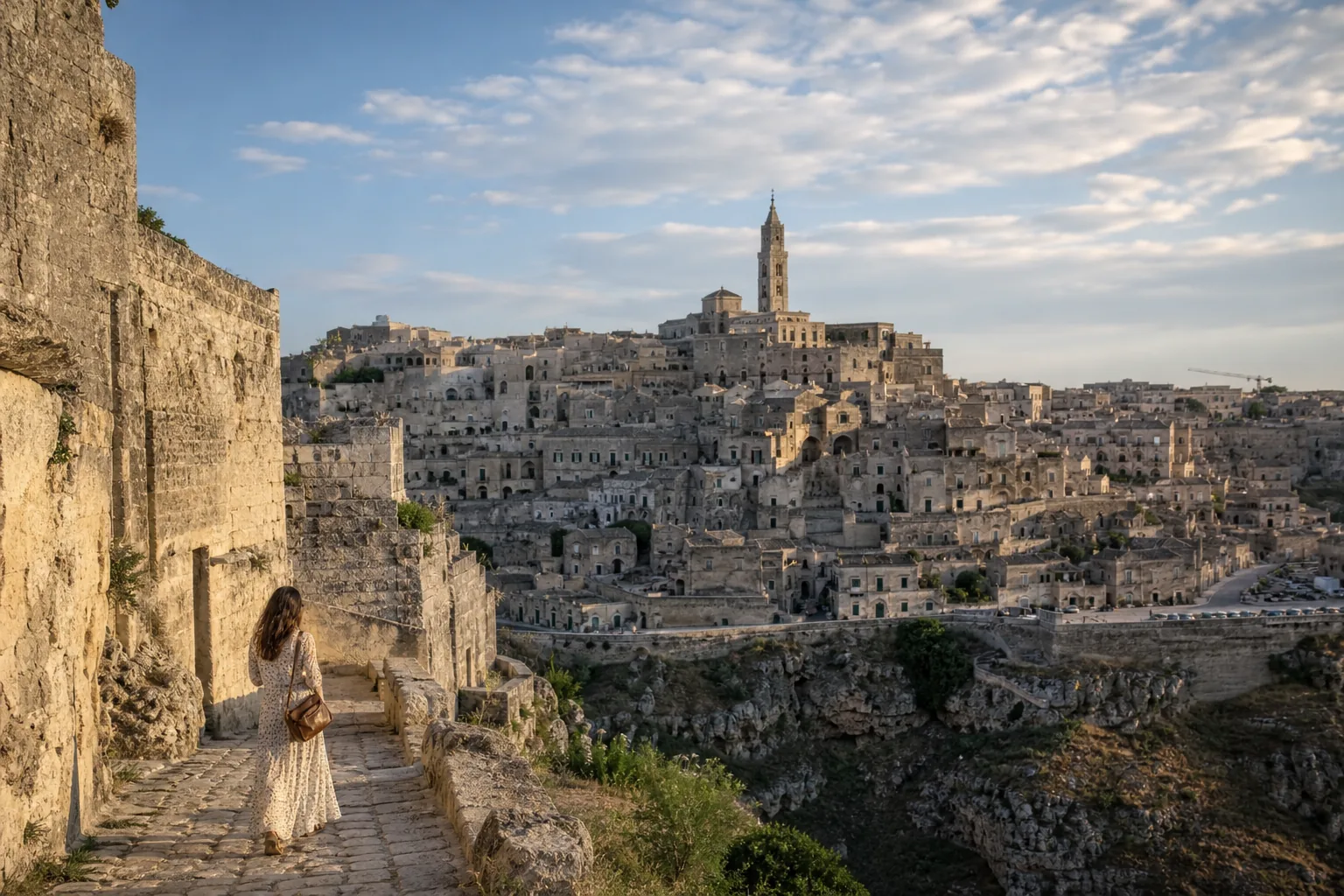
If you’ve been scrolling through travel content lately and keep seeing the same cities — Rome, Florence, the Amalfi Coast — you’re not alone in feeling like you want something different. Something that feels genuinely discovered rather than curated. A solid Matera Italy travel guide might just be the thing to shift your whole perspective on what a trip to Italy can look like, because Matera is unlike anywhere else on the planet. Carved into limestone cliffs in the deep south of Italy, this ancient city feels like stepping into another world entirely — one that most travelers are still sleeping on.
A City Older Than You Can Imagine
Matera sits in Basilicata, tucked into what geographers describe as the instep of Italy’s boot — far from the tourist circuits of the north, and even less visited than its southern neighbor Puglia. That remoteness is part of the magic. The city’s defining feature is its Sassi di Matera, a sprawling district of cave dwellings carved directly into the pale limestone ravines. People have been living in these caves for roughly 10,000 years, making Matera one of the oldest continuously inhabited settlements in the world.
That word “continuously” carries some weight, though. By the 1970s, Matera had become a ghost town — the first time in those 10,000 years that the settlement sat completely uninhabited. The caves had long been home to the city’s poorest residents, and the conditions were brutal enough that Matera earned the grim nickname “la vergogna d’Italia” — “the shame of Italy.” Families, livestock, and disease shared the same underground spaces. The government eventually relocated residents out of the Sassi, and for a while, the city fell silent.
Then came the revival. In the 1980s, a group of local creatives looked at those empty caves and saw something remarkable. They spotted the potential in the crumbling stone, in the labyrinthine alleyways, in the frescoed churches half-buried in the hillside. Slowly, Matera came back to life — and this time, on its own terms. Today, the Sassi di Matera is a UNESCO World Heritage Site, and the city has earned its place on the map not just as a curiosity, but as a genuinely vibrant destination worth staying in for days.
What the Sassi Actually Feels Like
No amount of photos really prepares you for the Sassi. When you first stand at the edge of the ravine and look down at the cascade of pale stone buildings — some carved into the cliff face, some stacked improbably on top of each other — it genuinely takes a moment to process. The whole district looks like it was sculpted rather than built. Staircases disappear into rock. Doorways lead into rooms that extend deep into the hillside. Rooftops become someone else’s courtyard.
There are two main Sassi areas: Sasso Caveoso and Sasso Barisano. Sasso Caveoso is the older, more rugged of the two — it feels wilder, less polished, and rewards slow exploration. Sasso Barisano, closer to the town center, has seen more restoration and is where you’ll find most of the restaurants, bars, and accommodation. Between them, you could easily spend a full day just wandering, ducking into cave churches, pausing at viewpoints, and getting pleasantly lost.
The frescoed cave churches scattered throughout the Sassi are genuinely stunning. Some of them date back to the Byzantine period, their walls still covered in faded but remarkable painted figures. You’ll stumble across them almost by accident — which is honestly the best way to find anything in Matera. The city rewards curiosity over itineraries.
→ Read also: Skip the Tourist Trail: Where to Stay in Italy's Best-Kept Secrets
Things to Do Beyond the Obvious
Yes, walking the Sassi is the main event. But Matera has more going on than its caves. Here’s how to build a few days that feel full without feeling rushed:
- Visit the cave churches. The rock-cut churches of the Sassi are among the most atmospheric places in all of Italy. Many are open to visitors, and some still hold religious services. The frescoes inside are extraordinary — fragile, ancient, and completely free of the crowds you’d find at comparable sites in Rome or Ravenna.
- Explore the Murgia plateau. Across the ravine from the Sassi, the Murgia plateau offers some of the best views of the city. You can hike across it in an hour or two, and the perspective from the other side — looking back at Matera lit up against the landscape — is one of those images you’ll carry with you for a long time.
- Spend time in the Piazza Vittorio Veneto. The main square of the Piano (the upper, newer part of the city) is a lively hub, especially in the evenings. Locals gather here, cafés spill onto the pavement, and the whole atmosphere shifts from daytime sightseeing to something slower and more social.
- Eat well and eat local. Matera has a serious food scene. The city is home to Michelin-starred restaurants, but it also has plenty of places where you can eat traditional Basilicatan cooking — think handmade pasta, lamb dishes, local cheeses, and the famous pane di Matera, a crusty, golden bread with a protected designation of origin. Don’t leave without eating it fresh.
- Check out the local museums. Several museums in Matera document the history of the Sassi and the lives of the people who lived there. Seeing the photographs and artefacts from the period when the caves were still inhabited adds a layer of depth to everything you see when you walk through the district.
Where to Stay: Sleep in a Cave
Here’s the thing that sets Matera apart from almost every other destination in Italy: you can actually sleep inside the ancient cave dwellings. Several of the restored Sassi properties have been converted into guesthouses and boutique hotels, where rooms are carved directly into the limestone. Waking up inside a cave — cool, quiet, and surrounded by centuries of history — is one of those travel experiences that sounds gimmicky until you’re actually doing it, and then it feels completely extraordinary.
Options range from small family-run guesthouses to more polished boutique properties, so there’s something for different budgets. Staying inside the Sassi rather than in a standard hotel on the upper town is strongly worth the effort to book. The atmosphere after dark, when the day visitors have left and the cave district is lit by warm lantern light, is something you genuinely can’t experience as a day tripper.
That’s worth underlining: many visitors come to Matera as a day trip from Puglia, which is understandable given that Matera is often marketed as a side trip from that more famous region. But Matera is actually in neighboring Basilicata, and treating it as a day trip means missing the best of it. Once the day trippers leave, the city transforms. The streets quiet down, the light changes, and the whole place takes on a completely different character — more intimate, more mysterious, more yours.
When to Visit and How to Make the Most of It
Matera is a year-round destination, but the experience shifts significantly depending on when you go. Spring — roughly from late March through May — is widely considered one of the most rewarding times to visit. The weather is mild, the light is golden, and the wildflowers on the Murgia plateau are in bloom. Crowds are manageable, and you’ll find the city feeling genuinely alive without being overwhelmed.
Early autumn, particularly September and October, offers a similar balance. The summer heat in southern Italy can be intense, and while Matera’s stone buildings stay naturally cool inside, the midday sun on the exposed limestone can be punishing in July and August. If you do visit in summer, plan your outdoor exploration for early morning and late afternoon — the golden hour light on the Sassi is worth setting an alarm for.
Winter is Matera’s quietest season, and there’s a strong argument for visiting then. The city feels deeply atmospheric in the cold and the mist, the cave churches are almost entirely to yourself, and the local restaurants and bars feel genuinely local rather than tourist-facing. If you’re comfortable with cooler temperatures and shorter days, winter Matera is a real hidden gem experience.
→ Read also: Hidden Gems Beyond the Guidebook: Greece's Milos, Italy's Capri, and Avoiding Tourist Traps
Regardless of when you go, arrive in the evening if you can. The Sassi lit up at night — all warm stone and soft light against a dark sky — is one of the most visually striking things you’ll see in Italy. And if you’re staying in the caves, you’ll have it almost entirely to yourself once the day visitors head back to their hotels in Bari or Lecce.
Getting There and Getting Around
Matera’s relative obscurity is partly a geography story. It’s not on a major rail line, which means getting there requires a bit more planning than hopping on a fast train from Rome. The most common approach is to fly into Bari (in Puglia, roughly an hour away by road) or Naples, and then take a bus or rent a car for the final stretch. There are also regional train connections, though they’re slower and less frequent than you might be used to.
A car is genuinely useful if you want to explore the surrounding Basilicata countryside — the landscape is wild and beautiful, and there are villages and natural parks in the region that are well worth a detour. But within Matera itself, you won’t need one. The Sassi are best explored on foot, and most of the city’s key sights are within walking distance of each other.
The terrain is hilly and the streets are often steep and uneven, so comfortable walking shoes are non-negotiable. Bring layers, especially if you’re visiting outside summer — the caves stay cool, and the evenings in Basilicata can turn cold quickly, even in spring and autumn.
Why This Matera Italy Travel Guide Matters Right Now
Here’s the honest truth about Matera: it’s not completely undiscovered. It has Michelin-starred restaurants, boutique cave hotels, and a UNESCO designation that draws visitors from around the world. But compared to the relentless crowds of Rome, Florence, or Venice, it still feels remarkably human-scale and manageable. You can explore the Sassi at your own pace, eat dinner without a reservation made three weeks in advance, and have genuine conversations with the people who live and work there.
That balance won’t last forever. Destinations like Matera tend to follow a predictable arc — discovery, buzz, overcrowding — and the smart move is to go while the experience still feels like something you found rather than something you were sold. National Geographic has called attention to Matera’s extraordinary character, and the word is slowly spreading. But for now, the city still rewards the traveler who’s willing to go a little further south, stay a little longer, and let the ancient stone work its way into them.
Matera is the kind of place that changes how you think about travel — not because it’s dramatic or overwhelming, but because it’s quietly, stubbornly, magnificently itself. You’ll walk through a city that has been lived in for 10,000 years, sleep inside its walls, eat its bread, and leave wondering why it took you so long to find it. That feeling is worth every extra hour on the road to get there.
This article was produced with AI assistance and reviewed editorially.


Matera: Where Ancient Caves Meet Modern Culture—Before Everyone Else Discovers It

The Kalka-Shimla Toy Train: Slow Down and Actually See India


