
Asia
Samarkand & Bukhara: Two Silk Road Cities That Feel Like Stepping Back in Time
Explore Samarkand and Bukhara, Uzbekistan’s iconic Silk Road cities. Compare landmarks, costs, transport, and seasonal weather to plan your visit.

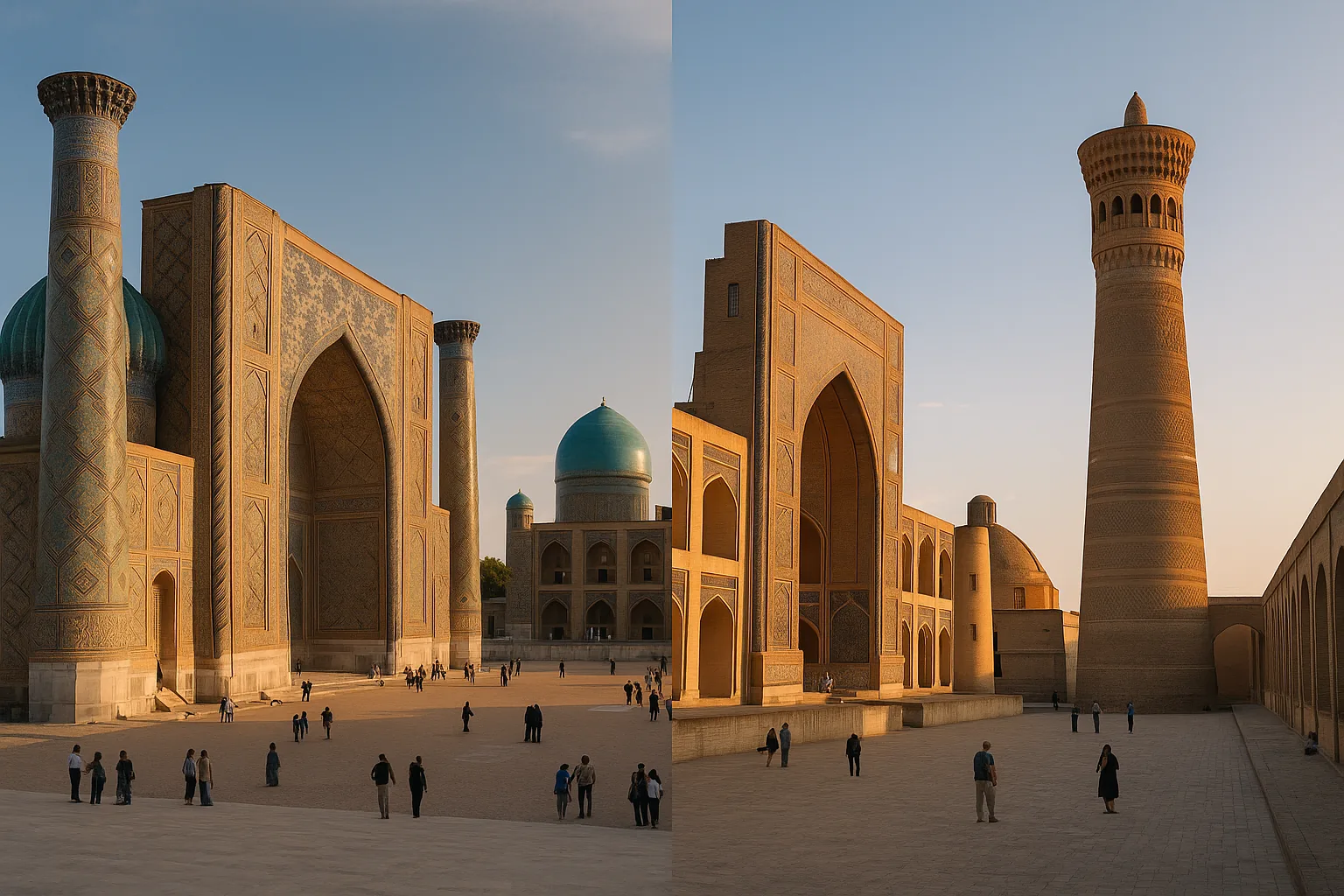
There are places in the world that feel like they exist slightly outside of time — where the architecture is so ancient and the atmosphere so layered with history that you half-expect to see a caravan of merchants rounding the corner. Samarkand and Bukhara are exactly those kinds of places. These two Uzbek cities sit at the heart of the old Silk Road, and together they offer one of the most genuinely transporting travel experiences available to anyone with a sense of curiosity and a willingness to wander. If you’re building a Central Asia itinerary and wondering whether to choose one over the other — don’t. Visit both. Here’s everything you need to know to make the most of them.
Why the Silk Road Still Matters to Modern Travelers
The Silk Road wasn’t a single road. It was a sprawling network of trade routes connecting East Asia to the Mediterranean, carrying not just silk and spices but ideas, religions, languages, and cultures across thousands of kilometers. At its peak, the cities along this network were among the wealthiest and most cosmopolitan in the world.
Samarkand and Bukhara were two of its most important hubs. Merchants, scholars, conquerors, and pilgrims all passed through — or stayed. The legacy of that era is still visible in the tilework, the minarets, the ancient bazaars, and the stories locals will tell you if you take the time to ask.
Today, Uzbekistan is one of the most underrated destinations for young travelers. It’s affordable, increasingly easy to navigate, and genuinely different from anything you’ll find in Western Europe or Southeast Asia. If you’re looking for a destination that will genuinely expand your perspective, this is it. The three main ancient cities — Samarkand, Bukhara, and Khiva — form a kind of historic triangle, and most travelers who visit one end up wishing they’d planned for all three.
Samarkand: Grand, Gleaming, and Impossible to Ignore
Samarkand hits you immediately. Unlike some historic cities that reveal themselves slowly, this one announces itself with a kind of architectural confidence that borders on theatrical. The city is described by many travelers as more modern than its reputation might suggest — there’s a real urban energy here, with wide boulevards, functioning neighborhoods, and a population going about daily life alongside the monuments.
But the monuments. Let’s talk about the monuments.
Registan Square is the centerpiece of Samarkand, and it’s one of those rare landmarks that genuinely lives up to the hype. Three enormous madrasas — Islamic schools — face each other across a vast open plaza, their facades covered in intricate geometric tilework in deep blues, turquoises, and golds. Standing in the middle of the square, especially at dusk when the light softens and the tiles seem to glow from within, is one of those moments that stays with you long after you’ve gone home.
Beyond the Registan, Samarkand rewards exploration. The Shah-i-Zinda necropolis — a long alley of mausoleums dating back centuries — is arguably even more emotionally affecting than the square. The tilework here is extraordinary, and the atmosphere is quieter and more contemplative. Local visitors come to pay their respects, and you’ll often find yourself sharing the space with families and elderly worshippers, which gives the site a living, breathing quality that pure tourist landmarks sometimes lack.
The Bibi-Khanym Mosque, once one of the largest mosques in the Islamic world, is another landmark that rewards a visit. Even in its partially restored state, the scale is staggering — the kind of building that makes you recalibrate your sense of what was possible centuries ago. Walk around the exterior, look up at the main arch, and take a moment to imagine what this place looked like at the height of the Timurid Empire.
Samarkand also has a lively market scene. The Siab Bazaar, located near the Bibi-Khanym Mosque, is a proper working market where you’ll find dried fruits, nuts, spices, fresh bread, and locals doing their weekly shopping. It’s the kind of place where you can spend an hour just watching and tasting, and leave with a bag full of snacks that will fuel the rest of your day.
Bukhara: Ancient, Intimate, and Quietly Unforgettable
If Samarkand is the grand statement, Bukhara is the quiet poem. This city has been standing for over 2,000 years, and it wears that age with a kind of easy dignity. Where Samarkand feels expansive and monumental, Bukhara is small and walkable, with narrow, winding streets that lead you from one discovery to the next without any particular plan.
👉 Read also: Uzbekistan's Silk Road Cities: Samarkand & Bukhara in 2026
Travelers consistently describe Bukhara as very different from Samarkand — and that difference is part of what makes visiting both so rewarding. Bukhara’s historic center is a UNESCO World Heritage Site, and much of it has been preserved in a way that feels organic rather than curated. You can wander for hours through the old town and stumble upon a centuries-old caravanserai, a bubbling fountain in a shaded courtyard, or a local craftsman working at a loom in a doorway.
The trading domes — ancient covered market structures that once served as the commercial heart of the Silk Road city — are a highlight. These aren’t museums. They’re still functioning as markets, selling silk, ceramics, embroidery, and jewelry. Ducking inside one of these domed spaces, with light filtering through the oculus above and the smell of spices in the air, is about as close as you’ll get to the Silk Road experience without a time machine.
The Ark Fortress dominates the city’s skyline and offers a window into Bukhara’s complex history as a seat of power. The Kalon Minaret, which has stood for nearly a thousand years, is one of those structures that earns your respect just through sheer persistence. Legend has it that even Genghis Khan was moved enough to spare it when he conquered the city. Whether or not that’s entirely accurate, the minaret is genuinely awe-inspiring — and the mosque and madrasa beside it complete a trio of buildings that define the city’s skyline.
Bukhara also has a thriving craft tradition that’s worth engaging with directly. Look for workshops where artisans produce traditional suzani embroidery, hand-painted ceramics, and miniature paintings. These aren’t factory souvenirs — they’re the continuation of skills passed down through generations, and buying directly from the maker means your money goes exactly where it should.
How the Two Cities Actually Feel Different Day to Day
Reading about two cities is one thing. But what does it actually feel like to spend time in each of them?
In Samarkand, you’ll feel the energy of a city that’s aware of its own significance. The major sites are well-maintained and draw visitors from across the world, which means the atmosphere around the Registan and other landmarks can feel busy — especially during peak season. That’s not a criticism; it’s just the reality of a city that knows it has something extraordinary to offer. Venture away from the main sites, though, and you’ll find quieter neighborhoods, local chaikhanas (teahouses), and a more everyday urban rhythm.
In Bukhara, the pace is slower. The old city is compact enough that you can cover a lot of ground on foot without feeling rushed, and the winding streets encourage a kind of aimless wandering that’s genuinely relaxing. You’ll find yourself stopping more often — to look at a doorway, to accept a glass of tea from a shopkeeper, to sit by a pool in a courtyard and just exist for a while. Bukhara rewards the traveler who’s willing to slow down and pay attention.
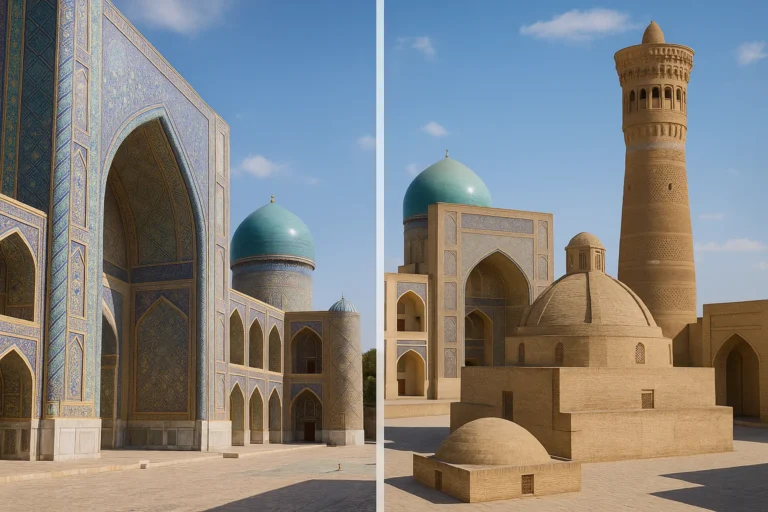
Both cities have good options for accommodation, ranging from budget guesthouses to beautifully restored boutique hotels set inside historic buildings. Staying in an old-town guesthouse in Bukhara, in particular, is an experience in itself — many of these properties are set around traditional courtyards and feel like a genuine step back into another era.
Getting Between Samarkand and Bukhara
The good news is that getting from one city to the other is genuinely easy. Uzbekistan has invested significantly in its transport infrastructure, and the connection between its major cities reflects that.
The high-speed train is the most popular option and for good reason. The journey is comfortable, the scenery through the Uzbek steppe is quietly compelling, and it drops you right into the heart of each city. It’s the kind of train journey that feels like part of the adventure rather than a logistical hurdle.
Shared taxis are another option if you want more flexibility or prefer to travel on your own schedule. They’re typically faster than the train but less comfortable for longer stretches. For most travelers, the train is the obvious choice — book your ticket in advance, especially during busy travel periods, to avoid being caught without a seat.
👉 Read also: Silk Road Cities for Culture Seekers: Samarkand, Bukhara & Tashkent in Uzbekistan
The distance between the two cities is manageable enough that you could theoretically do a day trip, but don’t. Both cities deserve at least two to three full days each to really sink into their atmosphere and see beyond the headline landmarks.
When to Go and What to Expect
Central Asia has a continental climate, which means the seasons are distinct and the timing of your visit genuinely matters. The most comfortable windows for exploring Samarkand and Bukhara are spring and autumn — roughly April through June and September through November.
Spring brings mild temperatures, blooming apricot trees, and a general sense of renewal that makes the cities feel especially alive. Autumn offers similar comfort levels, with the added bonus of harvest season produce in the markets and a golden quality to the afternoon light that photographers will appreciate.
Summer in Uzbekistan is genuinely hot — the kind of heat that makes midday sightseeing a test of endurance rather than a pleasure. If you visit in summer, plan your days accordingly: start early, rest during the hottest hours, and head back out in the late afternoon when the temperature begins to drop and the light becomes beautiful.
Winter is cold and sees fewer visitors, which means quieter sites and potentially lower prices — but also shorter days and a starkness that not everyone finds appealing. If you’re a traveler who loves having historic sites almost to yourself, a winter visit to Bukhara in particular can be remarkably atmospheric.
Practical Things Worth Knowing Before You Go
Uzbekistan has become significantly more accessible to international travelers in recent years. Visa requirements have been relaxed for many nationalities, and the country is increasingly set up to welcome independent travelers rather than just group tours.
- Currency: The Uzbek som is the local currency. Cash is widely used, especially in markets and smaller guesthouses, so carry enough with you.
- Language: Uzbek is the official language, and Russian is widely spoken, especially among older generations. English is becoming more common in tourist areas, but learning a few words of Uzbek or Russian will go a long way in earning genuine warmth from locals.
- Dress: Both cities have significant religious heritage, and dressing modestly — covering shoulders and knees — is both respectful and expected when visiting mosques and religious sites.
- Food: Don’t leave without trying plov (the national rice dish), samsa (baked pastries filled with meat or vegetables), and freshly baked non bread from a tandoor oven. Eating where locals eat will always give you a better meal at a fraction of the price of tourist restaurants.
- Photography: Both cities are extraordinarily photogenic, but always ask permission before photographing people, especially in religious spaces.
For a deeper dive into planning your Uzbekistan itinerary, The Collector’s guide to Samarkand and Bukhara on the Silk Road is a solid starting point with good historical context.
Why You Should Visit Both — Not Just One
It’s tempting, when time is short, to pick one city and skip the other. Resist that temptation. Samarkand and Bukhara complement each other in a way that makes the combination far more powerful than either city alone.
Samarkand gives you the grand sweep — the monumental architecture, the sense of empire, the sheer visual impact of a city that was once the center of the world. Bukhara gives you the human scale — the intimate alleyways, the living craft traditions, the feeling that you’re walking through a city that has continued without interruption for millennia.
Together, they give you something close to the complete picture of what the Silk Road actually was: not just a trade route, but a civilization. And as two of the most iconic jewels of the Silk Road, they represent a kind of travel experience that’s genuinely hard to find elsewhere — the feeling that history isn’t something you’re observing through glass, but something you’re actually moving through.
That feeling is what you’ll carry home with you. Not just photographs of blue-tiled domes and ancient minarets — though you’ll have plenty of those — but a shifted sense of the world’s scale and depth. Uzbekistan has a way of doing that to people. And once it does, you’ll already be thinking about when you can come back.
This article was produced with AI assistance and reviewed editorially.


Teaching English Abroad in 2026: Top Countries, Visa Requirements & Real Salaries

Where to Stay in Latin America’s Top Destinations: Buenos Aires, Bogota & Beyond


