
Asia
Central Asia’s Silk Road Cities: Samarkand & Bukhara—What Makes Each One Different
Discover what sets Samarkand and Bukhara apart. Both UNESCO Silk Road cities offer distinct experiences—one defined by striking architecture, the other by timeless atmosp

If you’re planning a trip to Uzbekistan, chances are you’ve already fallen down a rabbit hole of turquoise domes, ancient bazaars, and ochre desert landscapes. And somewhere along the way, you’ve probably found yourself staring at the classic Samarkand vs Bukhara debate, wondering which city deserves more of your time — or whether you even have to choose. The short answer is: don’t choose. Visit both. But understanding what makes each one genuinely different will completely change how you experience them, and that’s exactly what this guide is here to do.
The Silk Road Context You Actually Need
Before you step foot in either city, it helps to understand the world they were built for. Uzbekistan sits at the heart of Central Asia, and for centuries it was the crossroads of an extraordinary network of trade routes connecting China, Persia, the Arab world, and Europe. The term Silk Road itself was only coined in the 19th century by the German geographer Ferdinand von Richthofen, but the routes it describes are ancient — older than most of the monuments you’ll photograph.
Samarkand, Bukhara, and Khiva are all UNESCO-listed Silk Road oasis cities, each one a surviving fragment of a world that once traded in silk, spices, manuscripts, and ideas. They weren’t just stopovers. They were destinations in their own right — centres of scholarship, commerce, art, and power. Walking through them today, you feel that weight. The architecture isn’t decorative. It’s a record of civilisations that genuinely believed beauty and knowledge were worth building in stone and tile.
Knowing this shifts how you see both cities. You’re not just ticking monuments off a list. You’re standing in places that shaped the medieval world. That’s worth slowing down for.
Samarkand: Where Architecture Hits You Like a Wall
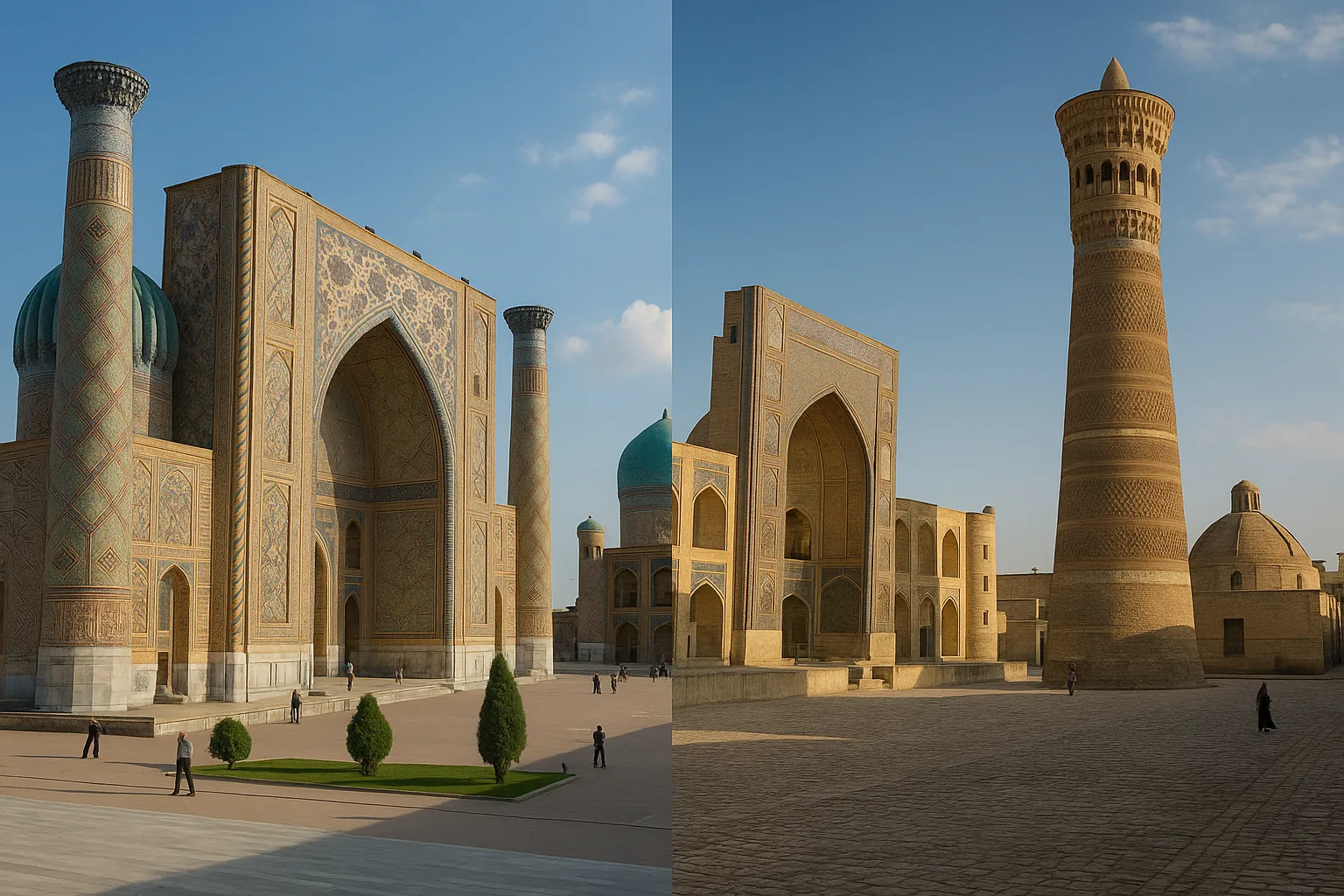
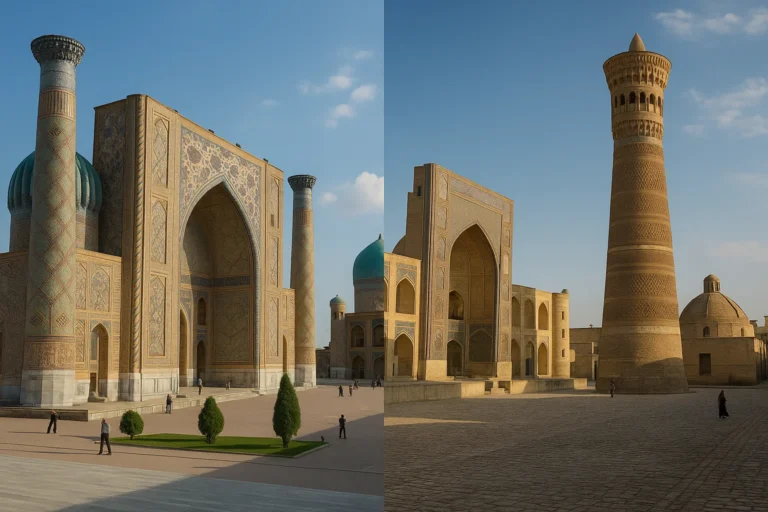
Samarkand is the one that usually appears first in your search results, and there’s a reason for that. The visual impact is immediate and overwhelming in the best possible way. The moment you arrive at Registan Square — the city’s iconic centrepiece — you understand why travellers have been writing about this place for centuries.
The city is defined by its Timurid-era architecture, characterised by those famous striking blue tiles and golden light that seem to shift depending on the time of day. Early morning, the domes glow almost green. At midday they’re a sharp, electric blue. At sunset, everything turns amber and the whole square feels like it’s been set on fire in the most photogenic way imaginable. If you’re the kind of traveller who photographs everything, Samarkand will genuinely test your storage capacity.
The Registan itself is a complex of three madrasas — Islamic schools — arranged around a central courtyard. Each one is different in detail but unified in scale and ambition. They were built to impress, and they still do. Beyond the Registan, you’ll find the Shah-i-Zinda necropolis, a long avenue of mausoleums tiled in every shade of blue and turquoise imaginable, and the Gur-e-Amir mausoleum, where the conqueror Timur himself is buried beneath a ribbed melon dome.
Samarkand is a city that was designed to announce power. It was rebuilt and expanded by Timur (also known as Tamerlane) in the 14th and 15th centuries as the capital of his empire, and that imperial ambition is baked into every façade. Everything is large. Everything is deliberate. Everything is meant to make you feel small in the most awe-inspiring way.
One thing worth knowing: some of Samarkand’s monuments have been heavily restored over the decades, and that’s a point of debate among travellers. The restoration work has kept the colours vivid and the structures intact, but it also means some corners feel newer than you might expect. That’s not a reason to skip it — the scale and beauty are undeniable — but it’s useful context for managing your expectations.
👉 Read also: Silk Road Cities for Culture Seekers: Samarkand, Bukhara & Tashkent in Uzbekistan
Bukhara: The City That Feels Like It Forgot to Stop Being Medieval
If Samarkand is a greatest-hits album, Bukhara is a deep cut that rewards the people who actually listen. Many travellers who visit both cities find themselves unexpectedly more moved by Bukhara — and it’s not hard to understand why once you’re there.
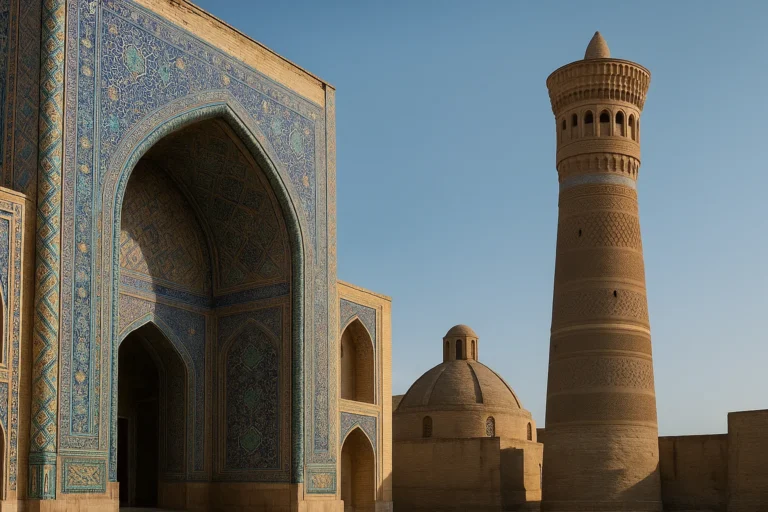
The difference starts with the texture. Where Samarkand dazzles with colour, Bukhara works in a quieter register. The city’s architecture is dominated by largely monochrome brickwork — warm, sandy, unrestored-looking walls that feel genuinely old rather than recently touched up. The effect is striking in a completely different way. You’re not gasping at colour. You’re leaning in, noticing the patterns in the brickwork, the way the light catches a carved wooden door, the shadows in a narrow alley.
Bukhara was a lively trading city for centuries, with merchants transporting goods from east to west along the Silk Road. That commercial energy left its mark on the urban fabric. The city’s historic centre is a dense, walkable maze of caravanserais (merchants’ inns), covered bazaars, mosques, and madrasas, all woven together without a clear separation between “monument” and “neighbourhood.” People live here. Bread is baked here. Tea is drunk in courtyards that have been used for exactly that purpose for hundreds of years.
This is why Bukhara is often described as feeling like a movie set — not because it’s fake, but because it’s so completely itself that it almost seems too good to be real. The Kalon Minaret, the Ark fortress, the Lyab-i Hauz pond surrounded by mulberry trees and tea houses — these aren’t isolated landmarks. They’re part of a living urban landscape that happens to be extraordinarily well-preserved.
Repeat visitors to Uzbekistan — people who’ve already done the big monuments and are coming back for something more — tend to spend more time in Bukhara. It’s a city that reveals itself slowly. The more you wander without a plan, the more you find.
Getting There: Tashkent, Trains, and the Practical Stuff
Most international flights into Uzbekistan land in Tashkent, the capital. It’s worth spending at least a day or two there before heading south — the city has its own energy, a mix of Soviet-era architecture and modern Central Asian urbanism that gives you useful context for everything you’ll see later. It’s also a good place to sort out any logistics, exchange money, and get your bearings before the Silk Road cities take over your brain.
From Tashkent, high-speed trains connect to both Samarkand and Bukhara, and the journey is genuinely part of the experience. The landscape outside the window shifts from urban sprawl to flat steppe to desert, and you start to feel the distances that those ancient traders covered on foot and horseback. Samarkand is closer to Tashkent — roughly a two-hour ride — while Bukhara is further west, adding another couple of hours to the journey.
A practical note: the most common route is Tashkent → Samarkand → Bukhara, and it flows well geographically. You can also add Khiva at the end if you have the time, though that requires either a domestic flight or an overnight train from Bukhara. If your schedule is tight, Samarkand and Bukhara together make a satisfying standalone trip.
In terms of accommodation, both cities have a strong tradition of guesthouses — family-run places often set in traditional courtyard houses. Staying in one of these, rather than a hotel, makes a real difference to how you experience the city. You’ll eat better, get better local advice, and feel more connected to where you actually are.
👉 Read also: Uzbekistan's Silk Road Cities: Samarkand & Bukhara in 2026
Solo Travel in Samarkand and Bukhara
Both cities are genuinely excellent for solo travellers, including first-timers to Central Asia. Uzbekistan has invested significantly in tourism infrastructure over recent years, and the result is a country that feels welcoming and navigable even if you arrive knowing very little.
Samarkand’s main monuments are clustered enough that you can cover the highlights on foot in a couple of days. The city is also large enough to have a lively café scene and a modern centre alongside the historic district, which means you won’t feel stranded if you want a break from sightseeing. There are plenty of other travellers around, which can be reassuring if you’re newer to solo travel — you’ll find conversation easily at guesthouses and around the major sites.
Bukhara feels slightly more intimate. The historic centre is compact, and after a day or two you’ll start recognising streets and faces. That sense of familiarity is part of what makes it special. Solo travellers often find that Bukhara encourages a slower pace — you’re less driven by a checklist of monuments and more likely to end up sitting in a courtyard talking to someone, or following a sound down an alley to find a local musician practising.
Language is rarely a barrier. English is widely spoken in tourist areas, and locals are generally warm and curious about where you’re from. Learning a few words of Uzbek or Russian — even just greetings — goes a long way and is always appreciated.
Which City Should You Spend More Time In?
Here’s the honest answer to the Samarkand vs Bukhara question: it depends entirely on what kind of traveller you are right now.
If you’re drawn to visual drama, monumental architecture, and the kind of sights that make your jaw drop, Samarkand will give you more of that per square metre. It’s the city you’ll want to photograph obsessively, the one you’ll describe in superlatives when you get home. Give it at least two full days — ideally three if you want to explore beyond the main sites.
If you’re more interested in atmosphere, texture, and the feeling of genuinely stepping into another era, Bukhara will stay with you longer. It’s the city that gets under your skin rather than overwhelming your senses. Many travellers who visit both find themselves wishing they’d spent more time in Bukhara — so if you can, build in an extra day.
The good news is that you don’t have to sacrifice one for the other. A well-planned trip to Uzbekistan can include both cities comfortably within ten days to two weeks, with time to breathe and wander rather than rushing between monuments. And if you find yourself at the end of your trip already planning a return visit — that’s completely normal. Central Asia has a way of doing that to people.
For a broader look at the Silk Road cities across the region, MIR Corporation’s guide to Uzbekistan’s Silk Road oasis cities is a solid starting point for deeper research before you go.
Whatever draws you there — the architecture, the history, the food, the sheer otherness of it all — Samarkand and Bukhara will each give you something the other can’t. That’s not a problem. That’s exactly the point. Go with an open itinerary, a willingness to get lost, and the understanding that some of the best moments in both cities won’t be at any monument at all — they’ll be in the spaces between, in the conversations you didn’t plan, and in the quiet realisation that you’re somewhere genuinely extraordinary.
This article was produced with AI assistance and reviewed editorially.


Southeast Asia Decoded: Hanoi 3-Day Itinerary + Vietnam Misconceptions Debunked

Central Asia’s Silk Road Cities: Samarkand & Bukhara—What Makes Each One Different


