
Asia
Southeast Asia Slow Travel: Luang Prabang, Saigon Day Trips & Real Ecotourism in Vietnam
Discover meaningful slow travel Southeast Asia experiences in Luang Prabang’s temples, Ho Chi Minh City day trips, and Vietnam’s authentic ecotourism destinations without

Why Slow Travel Southeast Asia Is the Most Rewarding Way to Explore the Region
There’s a version of Southeast Asia that exists purely on a checklist — temples ticked, photos taken, bus booked for the next morning. And then there’s the version you actually remember. Slow travel Southeast Asia isn’t a trend or a luxury reserved for people with unlimited time. It’s a mindset. It means staying long enough in one place to eat at the same noodle stall twice, to learn the name of your guesthouse owner, to watch a city breathe at its own pace rather than yours. This guide is for the traveler who wants that second version — who’s drawn to Luang Prabang’s golden temples, curious about what lies just beyond Ho Chi Minh City, and ready to explore Vietnam’s landscapes without leaving them worse off. Whether you have three weeks or three months, Southeast Asia rewards patience like almost nowhere else on earth.
Luang Prabang: The Heartbeat of Slow Travel in Laos
If there’s one city in Southeast Asia that was practically designed for slow travel, it’s Luang Prabang. This UNESCO World Heritage city in northern Laos sits at the confluence of the Mekong and Nam Khan Rivers, wrapped in a quiet that feels genuinely rare in the modern world. It’s not sleepy in a boring way. It’s calm in a way that makes you want to stay.
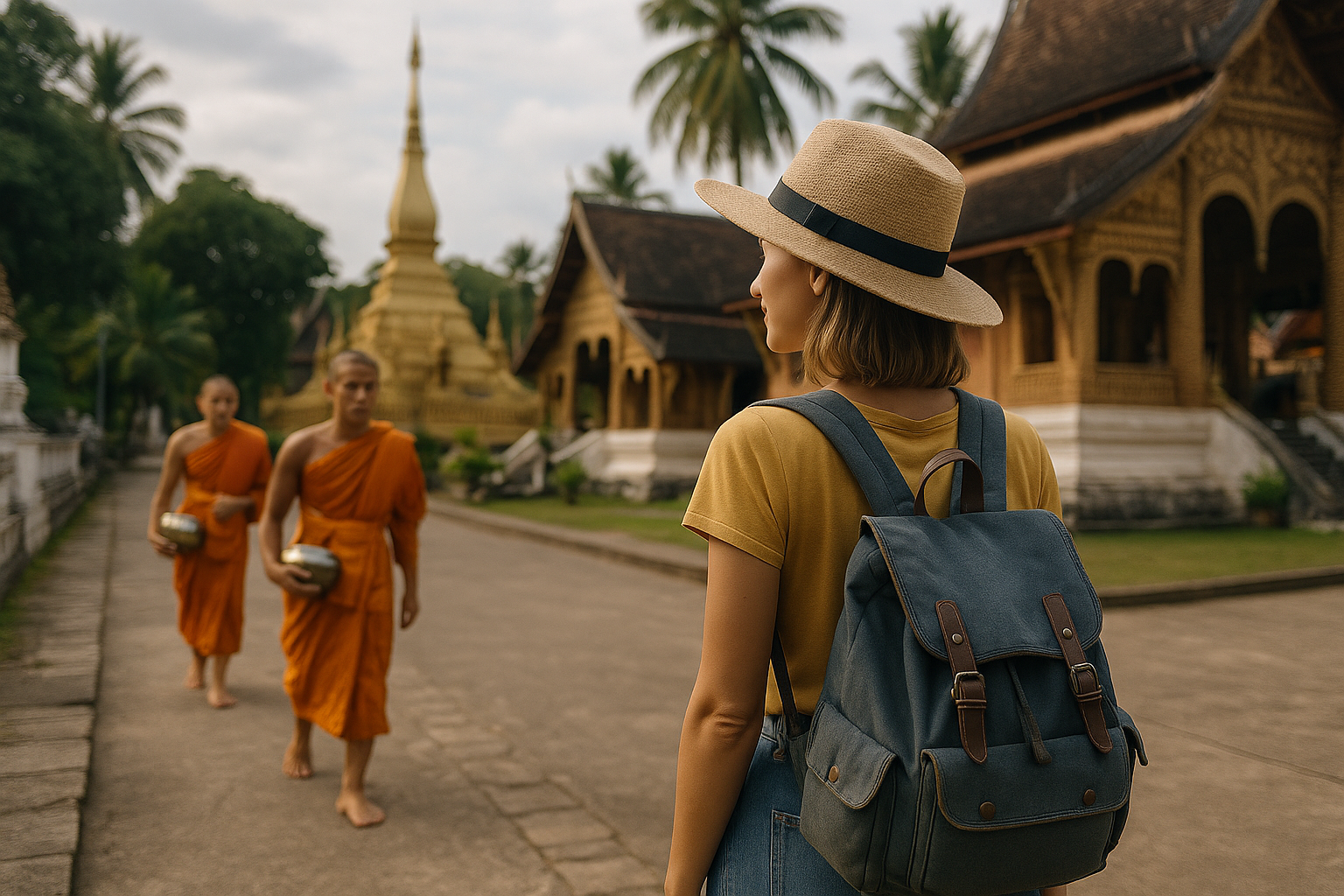
The city is a visual conversation between two histories. Traditional Laotian wooden shophouses line the main peninsula, their carved facades and terracotta rooftops sitting comfortably alongside French colonial architecture left over from a century of influence. Ornate Buddhist temples — there are dozens of them — punctuate nearly every street. Gold-tipped stupas catch the afternoon light. Monks in saffron robes move through the early morning mist. It sounds like a postcard, but standing in it feels completely different.
The Morning Alms Ceremony
One of the most powerful daily rituals in Luang Prabang is the tak bat — the almsgiving ceremony that takes place at dawn. Hundreds of monks walk silently through the streets collecting offerings of sticky rice from local residents. It’s a deeply spiritual practice, not a performance. If you choose to witness it, do so respectfully: keep your distance, stay quiet, and avoid flash photography. Watching from a café terrace with a cup of Laotian coffee is a perfectly respectful way to experience it without intruding.
How to Actually Slow Down Here
The classic backpacking route through Southeast Asia — Bangkok, Chiang Mai, Luang Prabang, Vang Vieng, Vientiane, and onward through Vietnam — often rushes through Luang Prabang in two or three nights. That’s not enough. Give it at least five days, ideally a week. Here’s what that kind of time allows you to do:
- Rent a bicycle and cycle out to the Kuang Si Waterfalls, spending a full afternoon swimming in the turquoise pools rather than arriving, photographing, and leaving.
- Take a slow boat along the Mekong — a two-day journey to the Thai border that has become legendary among travelers who value the journey over the destination.
- Wander into the smaller temples away from the main street, where you might find a monk willing to practice his English or a local artist working quietly in the shade.
- Eat at the night market every evening until you’ve worked through most of what’s on offer — grilled meats, sticky rice, fresh spring rolls, Laotian herbal teas.
- Sit by the Mekong at sunset and do absolutely nothing. That counts too.
Laos as a whole is widely recognized as one of the most rewarding destinations for slow travel in Southeast Asia — and Luang Prabang is the country’s soul. It has a pace that quietly insists you match it. Most travelers who do are glad they listened.
Beyond the City: Day Trips from Ho Chi Minh City
Ho Chi Minh City — still called Saigon by most people who live there — is one of the most energetic cities in Southeast Asia. The traffic alone is an experience. But after a few days of navigating its chaotic, thrilling streets, many travelers start wondering what’s just beyond the city limits. The answer is: quite a lot.
The countryside around Ho Chi Minh City is surprisingly diverse. Within a reasonable journey from the center, you can move from dense urban sprawl to river delta landscapes, colonial-era towns, war history sites, and fruit orchards where farmers have been doing the same work for generations. Lonely Planet covers several of the best day trips from Ho Chi Minh City, and the range of options reflects just how much the surrounding region has to offer.
The Mekong Delta
The Mekong Delta is the obvious first choice, and it earns that reputation. A network of rivers, canals, and islands stretches south from the city, and even a single day on the water gives you a completely different perspective on Vietnamese life. You’ll see floating markets, rice paddies, coconut candy workshops, and fishing villages that have barely registered the pace of change happening in the city to the north. If you can extend it to an overnight trip, do it — staying in a homestay along the river is one of those experiences that stays with you.
The Cu Chi Tunnels
Northwest of the city lies one of Vietnam’s most significant historical sites: the Cu Chi Tunnels, an extraordinary underground network used during the Vietnam War. Crawling through sections of the tunnel system — even the widened tourist-accessible passages — gives you a visceral sense of what life underground actually felt like. It’s not a comfortable visit, and it’s not meant to be. But it’s an important one, and it reframes the history in a way that no museum exhibit quite manages.
The Town of Mỹ Tho and Beyond
For something quieter, the riverside town of Mỹ Tho offers a gentler introduction to delta life — boat trips through narrow channels, fresh tropical fruit, and a pace of life that feels like a world away from Saigon’s constant motion. Combine it with a visit to one of the nearby islands and you’ve got a genuinely full day that costs very little and delivers a lot.
The key with day trips from Ho Chi Minh City is to resist the temptation to rush. Pick one destination and go deep rather than trying to combine three things into a single exhausting loop. That’s the slow travel principle at work, even on a short excursion.
Ecotourism in Vietnam: Finding What’s Real
Vietnam’s landscapes are extraordinary — from the karst mountains of the north to the coastal wetlands of the south. As the country’s tourism industry has grown, so has the number of operators claiming to offer “eco” experiences. Some of them genuinely do. Others have simply painted the word onto a sign and called it a day.
Authentic ecotourism isn’t just about being surrounded by nature. It’s about how that nature is managed, who benefits from your visit, and what impact you leave behind. Here’s how to tell the difference.
What Genuine Ecotourism Looks Like
Authentic ecotourism operations tend to share a few characteristics. They employ local guides from the communities they operate in, rather than bringing in outside staff. They keep group sizes small to minimize environmental impact. They’re transparent about where your money goes — and a meaningful portion of it goes back into conservation or community development. They’ll often have relationships with local environmental organizations or national park authorities.
When you’re researching an operator, look for these signals:
- Local ownership or meaningful local partnerships, not just a foreign-owned company with a green logo.
- Clear limits on group size — smaller is almost always better for genuine ecotourism.
- Guides who are from the region and can speak to its ecology and culture from personal knowledge.
- A stated environmental policy that goes beyond “leave no trace” platitudes.
- Honest information about what you’ll actually see, rather than overblown marketing promises.
Spotting Greenwashing
Greenwashing in tourism is frustratingly common. Watch out for operators who use environmental language heavily in their marketing but can’t back it up with specifics. If a tour calls itself “eco” but involves large buses, large groups, and a schedule that rushes you through natural areas without any real engagement, that’s a red flag. Similarly, “eco-lodges” that are simply hotels in rural areas, with no particular commitment to sustainability, are more common than they should be.
Ask direct questions before you book: How many people are in each group? Are your guides local? What percentage of revenue supports conservation or community programs? A genuine operator will welcome these questions. One that hedges or deflects probably doesn’t have good answers.
Vietnam’s Natural Landscapes Worth Exploring Responsibly
Vietnam has genuine ecological diversity that rewards responsible exploration. The northern highlands, with their terraced rice fields and forested valleys, are home to ethnic minority communities who have developed community-based tourism programs that offer travelers genuine cultural exchange while keeping economic benefits local. The central coast has mangrove ecosystems and wetland areas that support both wildlife and local fishing communities. In the south, the Mekong Delta’s waterways are an ecosystem in their own right, supporting biodiversity alongside one of the world’s most productive agricultural regions.
In each of these areas, the best experiences are usually the quietest ones — a morning walk with a local guide through forest trails, a boat trip on a canal with a family who’s fished there for generations, a meal cooked from ingredients grown within walking distance. These aren’t hard to find if you’re willing to look beyond the most-marketed options.
Koh Lanta and the Case for Thailand’s Quieter Side
Thailand tends to dominate conversations about Southeast Asia, and usually the same handful of destinations come up: Bangkok, Chiang Mai, Koh Samui, Phuket. But Thailand has a quieter side that aligns much more naturally with the slow travel philosophy, and Koh Lanta is one of its best examples.
This island in the Andaman Sea has managed to retain a relaxed character that many of its neighbors have traded away for mass tourism infrastructure. The main town along the east coast has a weathered, authentic feel — wooden shophouses on stilts over the water, a small Muslim community that has lived here for generations, fishing boats rather than party boats. The west coast beaches are long and relatively uncrowded, especially outside peak season.
Koh Lanta works particularly well for travelers who want to base themselves somewhere beautiful and explore at their own pace — kayaking through mangroves, snorkeling on nearby reefs, renting a scooter to find the beach that isn’t on any map yet. It’s the kind of place where a planned three-day stop turns into a week without you quite noticing how it happened.
Practical Notes for Slow Traveling Southeast Asia
A one-month trip through Thailand, Laos, and Vietnam is achievable on a budget of roughly $1,200 to $1,800 USD, depending on your travel style and how much you prioritize comfort versus cost. Slow travel can actually work in your favor financially — staying longer in one place means you can negotiate better rates on accommodation, eat where locals eat rather than where tourists are directed, and skip the constant cost of transport between destinations.
A few things worth keeping in mind as you plan:
- Visa requirements vary by nationality and change periodically — check the current requirements for each country well before you travel.
- The classic backpacking route is popular for good reason, but don’t feel obligated to follow it exactly. Some of the best experiences come from the detours.
- Shoulder seasons — the months just before and after peak tourist season — often offer the best balance of good weather and fewer crowds.
- Learning even a handful of words in the local language goes a long way. It signals respect, and people respond to it warmly.
- Slow travel means accepting that some days won’t go to plan. That’s not a problem. It’s usually where the best stories come from.
The Mindset That Makes It Work
Slow travel Southeast Asia isn’t about moving slowly for the sake of it. It’s about being present enough to actually absorb where you are. It’s the difference between visiting Luang Prabang and experiencing it. Between doing a day trip from Ho Chi Minh City and genuinely connecting with what you find there. Between booking an “eco” tour and actually supporting conservation.
The region rewards this approach more than almost anywhere else on earth. Southeast Asia has a texture and depth that reveals itself gradually — through conversations, through meals, through early mornings and late evenings in places that don’t make it onto highlight reels. The travelers who come back with the most vivid memories aren’t necessarily the ones who covered the most ground. They’re the ones who slowed down long enough to let the place leave a mark on them.
Give yourself that time. You won’t regret it.
This article was produced with AI assistance and reviewed editorially.


Nepal’s Mountain Gateway: Kathmandu Neighborhoods, Street Food & Where to Stay for Authentic Exploration

Luang Prabang, Laos: Why This Sacred City Is Perfect for Solo Travelers Seeking Solitude


