
Greece
Where to Stay in Greece: Island Hopping From Naxos to Milos in 2026
Find the best greece island accommodation across Naxos and Milos. Discover hotels, hostels, price ranges, and tips for choosing the right base for your Cyclades trip.



Where to Stay in Greece: Your 2026 Island-Hopping Guide from Naxos to Milos
Planning your greece island accommodation for a summer trip through the Cyclades is one of those decisions that can make or break your whole experience. Get it right, and you’ll wake up to turquoise water views, stumble into local tavernas that aren’t in any guidebook, and spend your nights exactly where you want to be — whether that’s dancing until sunrise or watching stars from a quiet terrace. Get it wrong, and you’ll spend half your trip commuting between the wrong part of the island and the places you actually want to see. This guide cuts through the noise and helps you figure out where to sleep, what to expect, and how to move between two of the Cyclades’ most compelling islands: Naxos and Milos.
Why Naxos and Milos Deserve a Spot on Your Itinerary
Both Naxos and Milos sit in the heart of the Cyclades, that iconic arc of Greek islands scattered across the Aegean Sea. They’re part of the same island group, which means island-hopping between them is genuinely practical — not just something travel bloggers suggest to sound adventurous.
What makes this particular pairing so good? They complement each other almost perfectly. Naxos is the largest island in the Cyclades, and it carries that scale with confidence — fertile valleys, a lively port town, long sandy beaches, and a sense that there’s always something else around the corner. It’s the kind of island where you can stay for a week and still not feel like you’ve seen everything.
Milos, on the other hand, is volcanic, dramatic, and a little more remote-feeling. Its coastline is sculpted into caves, arches, and coves in shades of orange, white, and deep blue. It attracts travelers who want something visually striking without the crowds that follow Santorini and Mykonos around like a shadow. Together, these two islands give you a well-rounded Cyclades experience — and the logistics of moving between them are manageable if you plan ahead.
Multi-island tours covering both Naxos and Milos (often alongside Paros and Santorini) are a popular option for travelers who want a structured itinerary without locking themselves into a rigid schedule. But if you’re the type who prefers to move at your own pace, independent travel works just as well — especially if you sort your ferries early.
Understanding Ferry Travel Between the Islands
Before you even think about greece island accommodation, you need to understand how you’re going to move between islands. Ferry travel is the backbone of any Cyclades trip, and there’s one thing worth knowing immediately: ferry tickets are booked individually for each leg of your journey. There are no multi-stop discount passes, and no return ticket deals. Every single crossing is its own booking.
This sounds annoying, but it’s actually freeing once you accept it. It means you can adjust your plans as you go — spend an extra day somewhere if you fall in love with it, or leave earlier if the vibe doesn’t click. Just don’t leave booking to the last minute during summer, because ferries fill up fast, especially on popular routes.
Ferryscanner is widely recommended as a ferry booking platform that supports multiple destinations across the Greek islands, making it easy to search routes, compare times, and book each leg of your trip in one place. Use it early, check the schedules, and build your accommodation plans around your confirmed ferry times — not the other way around.
Naxos: Where to Stay and What to Expect
The Port Town (Chora)
Naxos Town — locally called Chora — is where most travelers base themselves, and for good reason. It’s the island’s beating heart: a whitewashed maze of narrow streets climbing up toward a Venetian castle, a waterfront lined with cafés and restaurants, and a general energy that balances lively and laid-back in a way that’s hard to find elsewhere in Greece.
Staying in Chora puts you within walking distance of the ferry port, which matters more than you’d think when you’re hauling a backpack at 7am. You’ll also be close to the best restaurants, local shops, and the kind of evening atmosphere that doesn’t require any planning — just step outside and follow the noise.
Accommodation in Chora ranges from small family-run guesthouses tucked into the old town to budget-friendly hostels near the waterfront. If you’re traveling solo or with a group of friends, a hostel in this area gives you the social element that makes island travel feel connected rather than isolated. Look for places that offer rooftop terraces or communal spaces — those details make a real difference when you’re meeting other travelers.
The Beach Towns: Agios Prokopios and Agia Anna
If your priority is beach access over nightlife, the stretch of coast running south from Chora — particularly around Agios Prokopios and Agia Anna — is where you want to be. These are long, sandy beaches with calm water, making them genuinely ideal for anyone who wants to spend most of their day horizontal on a sunlounger.
This area is also why Naxos is consistently listed as one of the best Greek islands for family travel. The beaches are gentle, the water is shallow in places, and the overall pace is relaxed enough that you’re not constantly navigating crowds or noise. If you’re traveling with family — whether that’s younger siblings, parents, or your own kids — Naxos has an ease to it that more tourist-heavy islands simply don’t.
Accommodation along this coastal strip tends to be a mix of small hotels, studios, and apartment-style rentals. Studios with kitchenettes are particularly popular here because they give you flexibility — you can grab fresh produce from local markets and cook your own meals, which stretches your budget significantly over a longer stay.
The Interior Villages
Most travelers skip the interior of Naxos entirely, which means it’s exactly where you should consider spending at least a couple of nights. Villages like Halki and Filoti sit in the mountains, surrounded by olive groves and marble quarries, and they offer a completely different version of the island — quieter, cooler, and genuinely local.
Accommodation here is limited, which is part of the appeal. Small guesthouses and converted traditional homes are the norm. You’re not going to find a pool bar or a DJ set, but you will find excellent food, friendly locals, and the kind of slow morning that makes you wonder why you ever rush anywhere.
Milos: Where to Stay and What to Expect
Adamas: The Port Town
Milos’s main port, Adamas, is the practical choice for your first night on the island — especially if you’re arriving by ferry and want to get your bearings before committing to a more remote location. It’s a small town with a handful of restaurants, cafés, and accommodation options ranging from simple rooms to comfortable guesthouses.
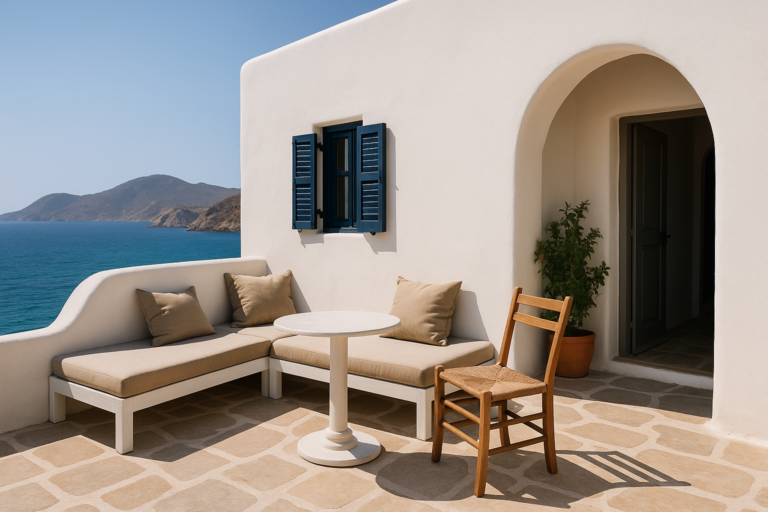
Staying in Adamas also gives you access to the island’s boat tour departures, which is genuinely one of the best ways to experience Milos. The island’s most spectacular coastline — the kind with sea caves, colored cliffs, and hidden coves that look almost unreal — is only accessible by boat or by hiking. Basing yourself near the port makes joining a morning boat tour straightforward.
Plaka: Views and Village Life
Plaka is Milos’s hilltop capital, and it’s one of those places you’ll still be thinking about long after you’ve gone home. It’s small, whitewashed, and perched high enough to give you sweeping views across the island and out to sea. Sunsets from Plaka are the kind that make you put your phone down and just look.
Accommodation in Plaka is mostly small guesthouses and boutique-style rooms, often with terraces overlooking the landscape. It’s quieter than Adamas and has a more intimate feel. If you’re traveling as a couple or want a slower, more reflective pace, Plaka is the right call. The village is walkable, the restaurants are good, and the atmosphere in the evening — when the day-trippers have left and the light turns golden — is genuinely special.
Pollonia: For Beach Access and a Younger Crowd
On the northern tip of Milos, Pollonia is a small fishing village that has quietly become a favorite among younger travelers. It’s got a relaxed beach vibe, a few good tavernas right on the water, and a generally easy atmosphere. It’s also the departure point for ferries to the neighboring island of Kimolos, if you want to add a spontaneous day trip to your itinerary.
Accommodation here is mostly studios and small hotels. It’s not the cheapest part of the island, but it’s not trying to be a luxury destination either — it sits in that comfortable middle ground where the quality is solid and the setting does most of the work.
How to Choose Your Greece Island Accommodation Based on Travel Style
If You’re Traveling Solo or With Friends
Prioritize location over room quality. Being in the middle of things — near the port, the main square, or the beach strip — matters far more than having a slightly nicer bathroom. Look for hostels or guesthouses with communal spaces, because those are where the actual connections happen. The best travel stories rarely start with “so I was alone in my hotel room.”
For Naxos, base yourself in Chora. For Milos, try Adamas or Pollonia. Both give you access to people, activities, and the spontaneous moments that define a good trip.
If You’re Traveling as a Family
Naxos is the stronger choice for families, and the beach towns south of Chora are the sweet spot. Look for studios or apartments with kitchen facilities — they give you flexibility around meal times and significantly reduce daily costs. Proximity to calm, shallow beaches matters more than nightlife access, and Naxos delivers on that without making you feel like you’ve ended up somewhere boring.
If You Want Solitude and Scenery
Milos is built for this. The island has a raw, geological beauty that rewards slow exploration. Stay in Plaka, rent a scooter or a small car, and spend your days finding beaches that don’t appear on the first page of any search result. Some of the best spots on Milos require a short hike or a boat ride, and that natural barrier keeps the crowds manageable.
Practical Tips for Booking Your Stay
- Book early for summer. July and August are peak season across the Cyclades. Accommodation fills up months in advance, especially on smaller islands like Milos where the total number of rooms is limited.
- Check the location carefully. On Greek islands, “close to the beach” can mean a five-minute walk or a twenty-minute drive. Read reviews, look at maps, and confirm exactly where you’ll be staying relative to where you want to spend your time.
- Consider shoulder season. Late May, June, and September offer a genuinely compelling alternative to peak summer. The weather is still excellent, the crowds are thinner, accommodation is more available, and the islands feel more like themselves.
- Look for places with breakfast included. On smaller islands, finding a good café in the morning can be harder than expected. A guesthouse that includes breakfast simplifies your mornings considerably.
- Don’t underestimate transport costs. If your accommodation is far from the main towns or beaches, factor in the cost of taxis, scooter rentals, or bus passes. On some islands, public transport is limited, and getting around adds up.
- Read recent reviews. Greece island accommodation quality can vary significantly from season to season. Reviews from the current or previous year are much more reliable than older ones.
Island Hopping Logistics: Putting It All Together
A practical approach to a Naxos-Milos trip might look something like this: fly into Athens, take a ferry to Naxos, spend four or five days exploring the island at a relaxed pace, then catch a ferry across to Milos for another three or four days before heading back to Athens. The total trip sits comfortably within ten days, which makes it manageable for most travel windows.
For a longer trip, you can add islands on either side of this route — Paros sits between Naxos and the mainland and is an easy addition, while Santorini is reachable from Milos if you want to end your trip with something iconic. Multi-island itineraries covering Milos, Paros, and Naxos are well-documented and genuinely work well as a circuit.
The key is to avoid cramming too many islands into too few days. Three nights minimum on each island gives you enough time to actually settle in, find your favorite spot, and stop feeling like a tourist moving through a checklist. The whole point of greece island accommodation isn’t just to have a bed — it’s to have a base from which you actually experience a place.
Final Thoughts: Choose Your Base, Then Let the Island Do the Rest
Greece’s islands have a way of surprising you. You’ll plan to spend a morning at the beach and end up sharing lunch with a local family who insists you try the homemade wine. You’ll intend to take the bus and end up hitching a ride with someone who shows you a viewpoint that isn’t on any map. That’s the nature of travel here — the structure you create through your accommodation choices gives you a starting point, and the island takes it from there.
Naxos and Milos offer two genuinely distinct experiences within the same island group, and choosing the right greece island accommodation in each place is what gives you the freedom to actually live those experiences rather than just pass through them. Do the planning, book early, stay somewhere that puts you close to the things you care about, and then let go of the rest. The Cyclades will handle the rest of the story.
This article was produced with AI assistance and reviewed editorially.


New Zealand’s Geothermal Wonders: Rotorua & Where to Stay for Adventure & Maori Culture

Adventure Beyond the Beach: Things to Do in Jeju, South Korea & Tayrona Park, Colombia


