
Tech Corner
Stay Connected Globally: Holafly eSIM Plans vs. Traditional SIM Cards for Young Travelers
Compare eSIM and traditional SIM cards for travel. Learn how Holafly eSIM plans save money, offer convenience, and keep you connected globally without surprise roaming ch

Why Staying Connected Abroad Is No Longer a Headache
Picture this: you land in Bangkok, your phone connects to a local network, and within seconds you’re navigating to your hostel, messaging your travel group, and posting that first photo of the trip. No hunting for a SIM card kiosk, no awkward language barrier at a phone shop, no waiting around. That’s the promise of modern travel connectivity — and the debate around eSIM vs SIM card travel is at the heart of it.
For young travelers especially, staying connected isn’t just a convenience. It’s a safety net, a navigation tool, a way to find hidden gems on the fly, and sometimes the difference between a smooth adventure and a genuinely stressful situation. So which option actually works best for you? Let’s break it all down.
What Is an eSIM and How Is It Different from a Traditional SIM Card?
A traditional SIM card is the small physical chip you slot into your phone. It ties you to a specific carrier and a specific number. When you travel internationally, you either pay your home carrier’s roaming rates — which can be brutal — or you swap in a local SIM card bought at your destination.
An eSIM, short for embedded SIM, is built directly into your phone’s hardware. Instead of a physical card, you download a carrier profile digitally. You can activate it before you even leave home, and in most cases you can keep your original number active at the same time on a dual-SIM setup.
The technology has been gaining serious momentum. Apple’s decision to remove physical SIM card slots from certain iPhone models pushed a wave of users toward eSIM adoption, and Android manufacturers have followed suit. If you’ve bought a flagship smartphone in the last couple of years, there’s a strong chance it supports eSIM — and if you haven’t explored that feature yet, traveling is the best reason to start.
For a deeper technical overview of how eSIM technology works, Holafly’s explainer on what an eSIM is gives a clear and accessible breakdown worth reading before your next trip.
The Real Cost of Traditional Roaming
Let’s talk about the thing nobody wants to deal with: the bill that arrives after a trip. Traditional roaming charges from major carriers can reach as high as $12 per day just for data access abroad. That might not sound catastrophic for a weekend trip, but stretch it across two weeks in Japan or a month backpacking through Southeast Asia, and you’re looking at a significant chunk of your travel budget disappearing into thin air.
Even if you skip roaming and buy a local SIM at your destination, the process has its own friction. You need to find a reputable shop, navigate a purchase in a language you might not speak, wait for activation, and then deal with the fact that some countries require passport registration before a SIM will work. It’s manageable, but it eats into your first hours in a new place — hours you’d rather spend exploring.
Then there’s the issue of multi-destination trips. If you’re doing a classic Europe circuit — say, Portugal, Spain, France, Italy — a local SIM from Lisbon won’t help you much by the time you reach Rome. You’re either buying multiple SIMs, relying on patchy Wi-Fi, or paying roaming fees between countries. None of those options are ideal.
eSIM vs SIM Card Travel: The Core Trade-Offs
Convenience and Setup
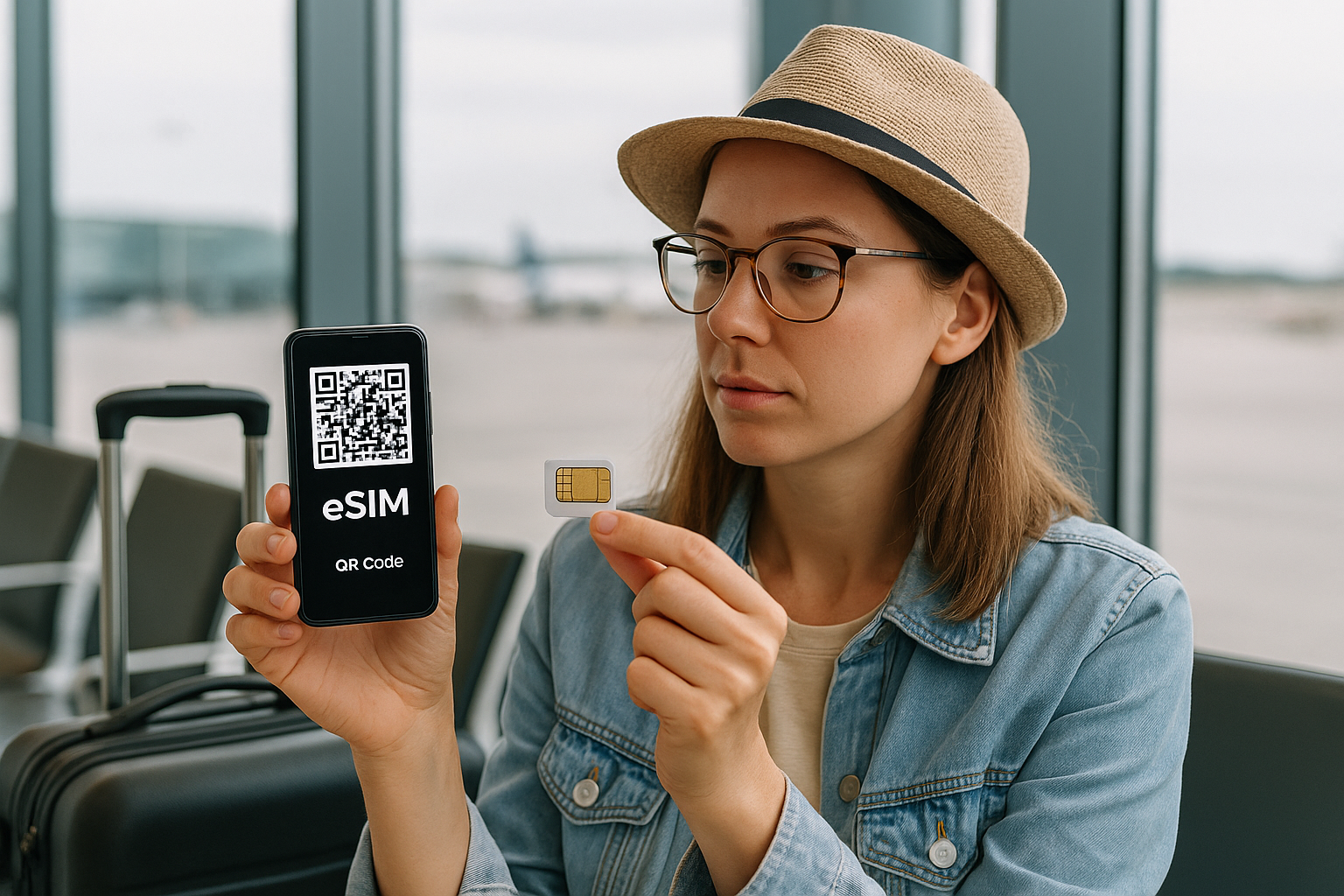
This is where eSIMs genuinely shine. You browse a plan online, purchase it, scan a QR code, and your phone is ready to connect the moment you land. No queues, no physical cards to lose, no activation delays. For spontaneous travelers who book last-minute or arrive at odd hours when phone shops are closed, this flexibility is hard to overstate.
Traditional SIM cards, on the other hand, require physical handling. They can be lost, damaged, or simply unavailable in the format your phone needs. If you’ve ever fumbled with a SIM ejector tool in a tiny hostel bathroom, you know the experience isn’t exactly seamless.
Device Compatibility
Here’s the honest caveat: eSIMs aren’t for everyone yet. Older smartphones, many budget Android devices, and some locked carrier phones don’t support eSIM technology. Before committing to an eSIM-only strategy, check your specific device’s compatibility. If your phone doesn’t support it, a physical SIM card is still a perfectly solid option — and in many destinations, local SIMs offer excellent value.
The gap is closing fast, though. As manufacturers continue phasing out physical SIM trays, eSIM compatibility is becoming the default rather than the exception.
Flexibility for Multi-Destination Travel
If your trip spans multiple countries, an eSIM with regional coverage is a game-changer. Rather than juggling several physical SIMs or paying roaming fees every time you cross a border, you can activate a single plan that covers your entire route. This is particularly valuable for trips through Europe or Southeast Asia, where country-hopping is part of the adventure.
Keeping Your Home Number Active
One underrated advantage of eSIM travel is the dual-SIM capability most modern phones offer. You can keep your home SIM active — so calls and texts from home still reach you — while your eSIM handles all your data abroad. This matters more than you might think when you’re waiting on an important message, need to verify an account via SMS, or simply want family to be able to reach you without hassle.
Holafly eSIM Plans: What They Offer
Among the eSIM providers that have built a reputation with travelers, Holafly is one of the most widely discussed. Their plans cover a broad range of destinations, including the USA, Europe, Japan, Canada, India, China, the UK, Mexico, France, Thailand, Australia, Italy, South Korea, the Philippines, Costa Rica, and New Zealand — a list that maps pretty neatly onto the destinations young travelers tend to prioritize.
Holafly operates on a data-focused model, which suits the way most travelers actually use their phones. You’re streaming maps, checking recommendations, sharing photos, and staying in touch via messaging apps — all data-driven activities. Their plans are prepaid, meaning no surprise charges and no ongoing commitment. You pick the duration and data allowance that fits your trip, activate it, and you’re good to go.
For the most current plan options and pricing, it’s worth checking Holafly’s prepaid eSIM plans page directly, since offerings and rates are updated regularly and vary by destination.
Who Is Holafly Best Suited For?
Holafly tends to appeal to travelers who value simplicity and reliability over hunting for the absolute cheapest deal. The setup process is designed to be straightforward, the customer support is accessible, and the activation is fast. If you’re heading somewhere for the first time and want one less thing to worry about, that peace of mind has real value.
It’s a particularly good fit for shorter trips — a week in Tokyo, two weeks in Southeast Asia, a summer interrailing through Europe — where you want consistent coverage without committing to a long-term plan. For extended travel, it’s worth comparing costs across providers to find the best value for your specific route.
Traditional SIM Cards: When They Still Make Sense
Let’s be fair to the humble physical SIM. In certain situations, it’s still the smarter choice.
- Your phone doesn’t support eSIM. Simple as that — if the technology isn’t available on your device, a local SIM is your best friend.
- You’re staying in one country for an extended period. If you’re spending a month in one place, a local SIM from a regional carrier often offers the best data rates, call packages, and network quality. Local knowledge matters here.
- You want a local number. Some situations — renting accommodation, booking local services, joining group chats — are easier with a local number. Physical SIMs typically provide this; many eSIM data plans don’t include a local calling number.
- You’re a frequent traveler who wants a reusable solution. Some physical SIM providers, like TravelSim, offer cards that work across 135 or more countries and are reusable across trips, with options like a money-back guarantee. For travelers who are constantly on the move across diverse destinations, this kind of product can offer a different kind of flexibility.
The bottom line is that neither option is universally superior. The best choice depends on your device, your itinerary, your budget, and how much friction you’re willing to tolerate.
How Connectivity Shapes the Travel Experience
Beyond the practical logistics, there’s something worth acknowledging about what reliable connectivity actually means when you’re traveling young and often solo.
It means you can share your location with someone you trust when you’re heading somewhere unfamiliar at night. It means you can look up whether that street food stall has good reviews or whether that neighborhood is safe to walk through. It means you can connect with other travelers in real time, find out about a last-minute event, or change your plans when something unexpected comes up — which, in the best kind of travel, it always does.
Connectivity also means freedom from the anxiety of being unreachable. There’s a difference between choosing to go off-grid intentionally and being cut off because your roaming charges ran out. One feels liberating. The other just feels stressful.
That’s why the eSIM vs SIM card travel question isn’t purely about money or technology. It’s about how you want to experience your journey. The right connectivity setup is the one that gets out of your way and lets you focus on what actually matters — the places, the people, the moments.
Practical Tips for Choosing Your Travel Connectivity
- Check your phone’s eSIM compatibility before you travel. Look up your specific model — most manufacturer websites list this clearly.
- Buy your eSIM plan before you leave home. Activation is faster when you’re on a familiar Wi-Fi network, and you’ll land ready to go.
- Compare regional vs. country-specific plans. If you’re visiting multiple countries, a regional eSIM plan often works out cheaper and simpler than buying separate plans for each destination.
- Keep a backup option. Download offline maps before you travel. Know the address of your accommodation. Have a small amount of local cash. Connectivity is reliable, but no technology is perfect.
- Read the fine print on data limits. Some plans offer “unlimited” data with speed throttling after a certain threshold. Know what you’re getting so you’re not caught off guard.
- Check if your destination requires SIM registration. Some countries require passport verification for any SIM, physical or eSIM. This is usually handled digitally for eSIMs, but it’s worth confirming in advance.
The Bigger Picture: Connectivity as Part of Smart Travel
The way we travel is changing. Young travelers today are more informed, more resourceful, and more connected than any generation before them — and the tools available to support that style of travel are genuinely impressive. The conversation around eSIM vs SIM card travel is just one piece of a larger shift toward travel that’s more flexible, more spontaneous, and less dependent on rigid plans.
Providers like Holafly have made it easier than ever to arrive somewhere new and hit the ground running. Physical SIM cards still have their place, especially for budget-conscious long-term travelers or those with older devices. And the right answer for you might be different from the right answer for the person in the next hostel bunk.
What matters most is that you go in informed. You know your options. You understand the trade-offs. And you’ve made a decision that works for your trip, your device, and your travel style — not just the one that was most convenient to click on.
Because the best adventures start with good preparation, and the best preparation is the kind that becomes invisible once the journey begins. Sort your connectivity before you go, and then forget about it. The world is waiting, and there are far better things to think about than phone plans once you’re out there exploring it.
This article was produced with AI assistance and reviewed editorially.


New Zealand’s Geothermal Wonders: Rotorua & Where to Stay for Adventure & Maori Culture

Adventure Beyond the Beach: Things to Do in Jeju, South Korea & Tayrona Park, Colombia


