
Greece
Greek Islands Beyond Santorini: Milos’s Hidden Beaches and Caves, Plus Family-Friendly Options
Discover family-friendly Greek islands beyond Santorini. Explore Milos’s 70+ beaches, caves, and villages with practical tips for traveling with children of all ages.

Why Greek Islands Family Travel Is Better When You Skip the Obvious
Everyone knows Santorini. The white-domed churches, the Instagram-famous sunsets, the cliffside restaurants with waiting lists longer than your flight time. And honestly? It’s beautiful. But when you’re planning greek islands family travel — whether you’re a young parent, a sibling tagging along, or a group mixing different ages — the most famous spots aren’t always the most rewarding ones. The crowds can be overwhelming, the terrain tricky with little ones, and the prices steep enough to make your eyes water.
That’s where islands like Milos come in. Dramatic, raw, and still genuinely low-key, Milos offers something that feels increasingly rare in the Greek islands: space to breathe. More than 70 unique beaches stretch across its coastline, carved into volcanic rock formations that look like they belong on another planet. It’s the kind of place where you can spend a week and still feel like you’ve only scratched the surface. And for families — from toddlers to teenagers — it works in ways that the more famous islands simply don’t.
This guide covers what makes Milos special, how to explore its beaches, caves, and hidden corners, and how to approach Greek island travel with family in tow, whatever that looks like for you.
Milos: The Island That Surprises Everyone
Milos sits in the southwestern Cyclades, and its geology is unlike anything else in the archipelago. Millions of years of volcanic activity have sculpted the coastline into something extraordinary — cliffs that glow white in the afternoon sun, sea caves you can swim into, and rock formations that shift color as the light changes through the day.
Two spots define Milos for most first-time visitors, and both live up to the hype.
Sarakiniko: The Lunar Landscape
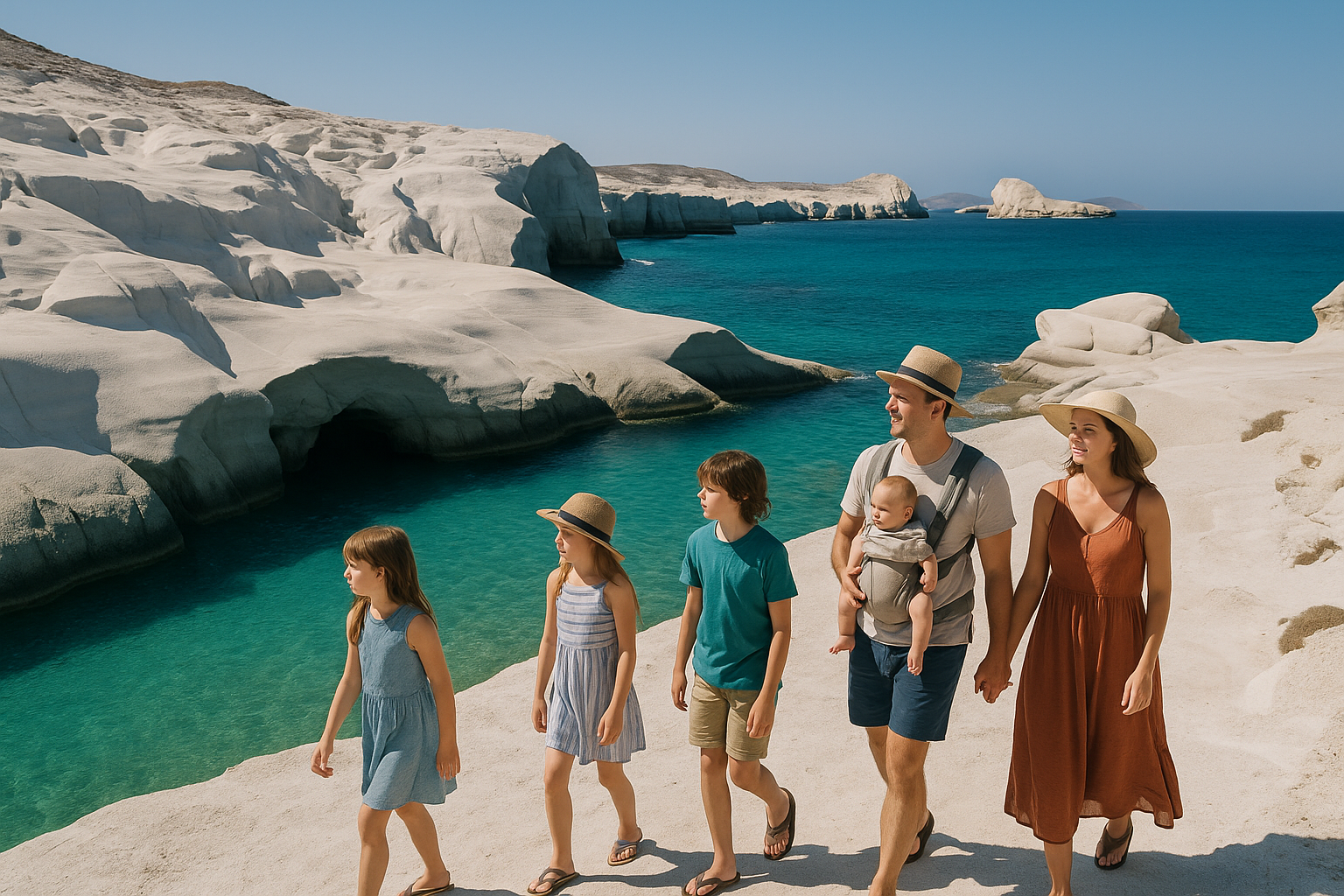
Sarakiniko is the kind of place that makes you stop mid-sentence. The white pumice rock formations roll down to the sea in smooth, rounded shapes, bleached by sun and wind into something that genuinely looks like the surface of the moon. The water below is a deep, clear blue that contrasts sharply with all that white stone. You can scramble across the rocks, find a sheltered ledge to lay out a towel, or jump into the sea from the lower outcrops if you’re feeling adventurous.
It’s accessible, photogenic, and endlessly explorable. Younger kids love the texture of the rocks and the shallow coves. Teenagers will want to find the best jumping spots. Adults just tend to stand there for a while, taking it in.
Kleftiko: White Cliffs and Sea Caves
Kleftiko is only reachable by boat, which is part of what makes it feel so special. The white cliffs rise dramatically from the sea, and the caves cut into the base of the rock are large enough to swim through. The water inside shifts between shades of turquoise and emerald depending on the angle of the light. It was historically used as a hideout by pirates — the name reflects that — and there’s still something slightly secretive about the place, even when boats are anchored nearby.
Most visitors reach Kleftiko on a boat tour that circles the island, stopping at multiple spots along the way. It’s one of the best ways to see the coastline in a single day, and it works well for mixed-age groups because the pace is relaxed and you’re never far from the boat.
Things to Do in Milos Beyond the Famous Spots
Milos rewards curiosity. The more you explore beyond the headline attractions, the more it gives back. The island has a strong local identity — fishing villages, traditional boat garages called syrmata built directly into the cliffs, and a pace of life that hasn’t been entirely reshaped by tourism. That’s part of what makes it such a good destination for travelers who want something genuine.
Explore the Villages
Plaka, the capital, sits on a hilltop and offers sweeping views across the island and out to sea. It’s a compact, walkable village with narrow streets, a castle at the top, and a handful of good places to eat. Klima, down by the water, is one of the most photographed villages in Greece — rows of colorful syrmata reflected in the calm bay. Neither place is overrun. You can wander without feeling like you’re part of a tour group.
Snorkeling and Swimming
With more than 70 beaches to choose from, you could spend an entire trip just moving from one to the next and never feel like you’ve repeated yourself. Some are long sandy stretches, others are small rocky coves accessible only by boat or a short hike. The water clarity is exceptional across the island, which makes snorkeling genuinely rewarding even for beginners. Shallow, calm bays are easy to find, which matters when you’re traveling with younger swimmers.
Visit the Catacombs
Milos has an early Christian catacomb network that’s open to visitors — one of the most significant early Christian sites in the eastern Mediterranean. It’s cool, quiet, and genuinely interesting, especially if you’re traveling with teenagers who appreciate a bit of history with their beach days. The site is well-maintained and the guided visits are short enough to hold attention without dragging.
Boat Tours Around the Island
A full-day boat tour is one of the best things you can do on Milos, regardless of who you’re traveling with. You’ll reach beaches and caves that are impossible to get to by road, swim in multiple spots, and get a sense of the island’s scale and variety. It’s also a social experience — you’ll likely share the boat with other travelers, and there’s something about being out on the water together that tends to bring people out of their shells.
Hiking and Coastal Walks
The island has a network of walking trails that connect villages and lead to viewpoints and beaches. Some are short and easy, others take a couple of hours and involve some elevation. The views from the higher paths are worth the effort — you get a completely different perspective on the coastline, and the volcanic landscape looks even more dramatic from above. Early morning or late afternoon are the best times to walk, when the heat is manageable and the light is at its most interesting.
Greek Islands Family Travel: Practical Advice That Actually Helps
Traveling with family across the Greek islands involves more logistics than a solo trip, but it’s far more manageable than people often assume. The key is choosing the right islands, the right time of year, and the right base — and then giving yourself permission to slow down.
Resources like SantoriniDave’s guide to Greek islands for families and the Find Us Lost family-friendly island guide are worth bookmarking early in your planning process. They cover practical considerations that general travel guides often gloss over.
Choosing the Right Island for Your Group
Not all Greek islands are equally suited to family travel. Some are better for toddlers and young children — flatter terrain, calmer beaches, easy access to amenities. Others work better for teenagers, who need more to do and more freedom to explore independently.
Milos sits in a genuinely useful middle ground. It’s described consistently as a low-key island with beaches that suit families well — calm, clear water, varied terrain, and enough going on to keep different ages engaged without being overwhelming. It’s not a party island, which matters when you’re sharing space with people of very different ages and energy levels.
Islands like Corfu and Rhodes offer more developed infrastructure — larger resorts, more facilities, easier logistics — which can be a real advantage when you’re traveling with infants or very young children. Naxos is another strong option, with long sandy beaches, a charming main town, and a relaxed atmosphere that suits families who want flexibility.
When to Go
For greek islands family travel, timing matters more than people realize. The peak summer months bring intense heat, heavy crowds, and higher prices. Traveling in late spring — roughly May into early June — or in early autumn, through September into October, gives you much more comfortable conditions. The sea is still warm enough to swim in, the crowds are noticeably thinner, and the atmosphere on most islands shifts into something more local and relaxed.
If you’re traveling with school-age children, the constraints of the academic calendar are real. But even within the summer window, the difference between early July and mid-August can be significant. Earlier in the season, before the peak rush, is generally the better choice.
Getting Around
Ferries are the backbone of island-hopping in Greece, and they’re more family-friendly than they might seem. The main ferry routes are well-established, the boats are large and comfortable, and the journey times between many of the Cyclades islands are short enough to manage without too much disruption to routines. Booking in advance during peak season is essential — both for the ferry crossings and for accommodation.
On the islands themselves, renting a car gives you the most flexibility, especially on larger islands or those with spread-out beaches like Milos. Scooters are popular but less practical with young children. In smaller villages, walking is usually the best option anyway.
Accommodation Considerations
The Greek islands offer a wide range of accommodation, from small family-run guesthouses to larger hotels with pools and multiple facilities. For families, self-catering apartments or villas are often the most practical choice — you get kitchen access, more space, and the flexibility to manage your own schedule without being tied to hotel meal times.
In more popular destinations, family rooms and interconnecting room setups are increasingly common in mid-range and upper-range hotels. Booking directly with smaller properties often gives you more room to discuss specific needs — cots, high chairs, ground-floor access — than booking through larger platforms where those details can get lost.
Activities That Work Across Different Ages
One of the genuine challenges of greek islands family travel is keeping everyone engaged when the age range is wide. A ten-year-old and a sixteen-year-old have very different ideas of a good day. So do a toddler and a teenager. The good news is that the Greek islands, and Milos in particular, offer enough variety that you can usually find something that works for everyone — or split the group and reconvene for dinner.
For Younger Children
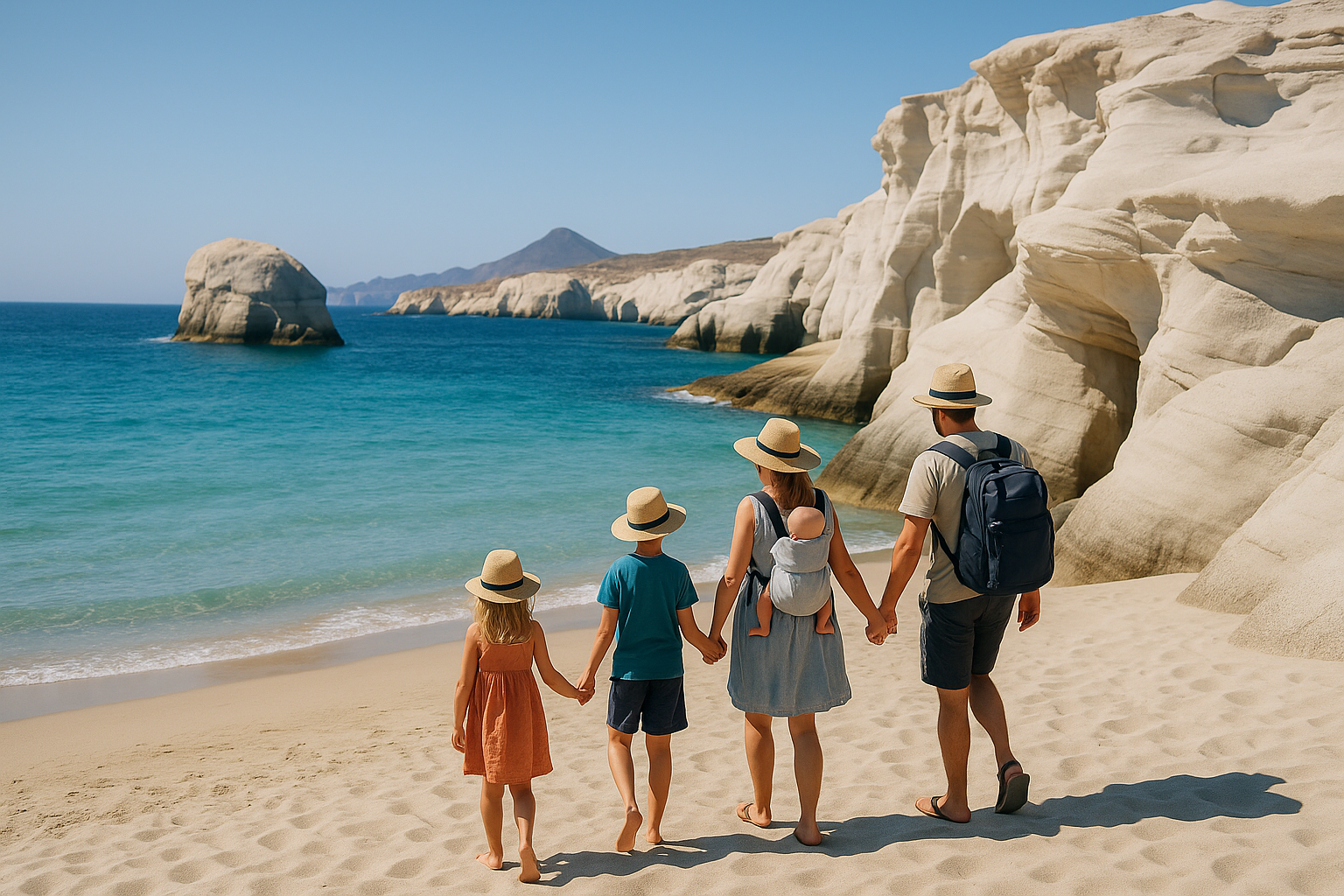
Calm, shallow beaches are the foundation of a good day for young kids in Greece. Look for bays that are sheltered from wind and swell, with gradual entry into the water. Sandy beaches are easier than rocky ones for small feet. Many of the smaller islands have exactly this kind of beach in abundance, and Milos has several that fit the description well.
Village exploration is also surprisingly engaging for young children — the narrow streets, the cats everywhere, the bakeries with fresh pastries in the morning. Keep the pace slow, build in rest time, and don’t try to pack too much into a single day. The Greek rhythm of life, with its long lunches and afternoon quiet, actually suits traveling with young children better than you might expect.
For Teenagers
Teenagers in the Greek islands tend to thrive when they have some independence and some genuine adventure on offer. Boat tours, cliff jumping, snorkeling, hiking to viewpoints — these are the kinds of activities that land well. Milos specifically has enough variety that a teenager with any sense of curiosity will find plenty to engage with.
The social side matters too. Greek island towns come alive in the evening, and the atmosphere in a good taverna — good food, relaxed pace, people-watching — is genuinely enjoyable for older teenagers who are starting to appreciate that kind of experience. It’s also a good opportunity to talk about the culture, the history, and the place itself in a way that feels natural rather than educational.
Why Milos Deserves a Spot on Your Greek Islands List
There’s a reason that travelers who discover Milos tend to talk about it the way people used to talk about Santorini before the crowds arrived. It has the geological drama, the extraordinary beaches, and the authentic local character that make the Greek islands so compelling — but without the sense that the whole place has been optimized for tourism at the expense of everything else.
For anyone planning greek islands family travel right now, Milos is one of the most compelling options available. It’s accessible, it’s varied, and it rewards the kind of curious, unhurried exploration that makes travel genuinely memorable rather than just visually impressive. The caves at Kleftiko, the lunar rock of Sarakiniko, the fishing villages, the boat tours, the quiet mornings before the day heats up — these are experiences that stay with you.
And that’s really the point. The Greek islands at their best aren’t about ticking off the famous viewpoints. They’re about the afternoon you spent swimming through a sea cave, the meal you had at a table on the edge of a harbor, the moment you scrambled up a white rock formation and looked out at a sea so blue it almost didn’t seem real. Those are the stories worth collecting — and Milos, along with the wider archipelago, has more of them than most places on earth.
Start with Milos. Explore slowly. Let the island show you what it’s got. You’ll understand quickly why travelers who’ve been there once are already planning to go back.
This article was produced with AI assistance and reviewed editorially.


City Guides for Young Travelers: Buenos Aires, Quito, and Trujillo (Culture, Food & Adventure)

Where to Stay in Southern Africa: Botswana, Namibia & Madagascar for First-Time Visitors


