
Portugal
Portuguese Islands Showdown: Azores vs Madeira (Local Perspective)
Compare Azores and Madeira with a local Portuguese perspective. Discover volcanic landscapes, best activities, seasons, costs, and which island suits your travel style.



Two Islands, One Big Decision: Azores vs Madeira
If you’ve been dreaming about escaping to a Portuguese island — volcanic lakes, dramatic cliffs, lush green trails, and ocean as far as the eye can see — you’ve probably already found yourself stuck in the classic debate: Azores vs Madeira. Both archipelagos belong to Portugal, both sit out in the Atlantic, and both will absolutely ruin you for ordinary travel. But they’re not the same place, and the one that suits you depends entirely on what kind of traveler you are. This guide breaks down both destinations honestly, so you can stop overthinking and start packing.
What Makes the Azores Different
The Azores is an archipelago of nine islands scattered across the mid-Atlantic, and the first thing you notice when you land is that it feels genuinely remote. Not in a scary way — in a this-place-exists-and-I-can’t-believe-I’m-here way. The islands are relatively large, and each one has its own personality. São Miguel is the most visited and the easiest starting point, and it’s the kind of island you can explore comfortably by car, winding past crater lakes, hot springs, and tea plantations that seem to appear out of nowhere.
The landscape here is volcanic and alive. You’re walking across land that’s still actively shaped by geological forces, and you feel that energy everywhere — in the steaming fumaroles, in the impossibly green hillsides, in the twin lakes of Sete Cidades sitting inside an ancient caldera. Travelers who’ve visited São Miguel have ridden e-bikes around Sete Cidades and described it as one of the most surreal cycling experiences they’ve ever had. That tracks. The scenery is the kind that makes you stop pedaling just to stare.
One thing to know before you go: the Azores experience pretty constant Atlantic winds, and the weather can change fast. You might get four seasons in a single afternoon. That’s part of the charm, honestly — it keeps things unpredictable and makes every clear-sky moment feel earned. It also means layering is your best friend, no matter what time of year you visit.
What to Do in the Azores
- Hike the calderas: The volcanic craters on São Miguel and other islands offer some of the most dramatic walking trails you’ll find anywhere in Europe. The views from the rim of Sete Cidades are genuinely unforgettable.
- Swim in natural thermal pools: The geothermal activity means you can find natural hot springs and warm coastal pools — Caldeira Velha is a classic stop.
- Go whale watching: The Azores sits along major whale migration routes, and cetacean sightings here are among the most reliable in the world. Blue whales, sperm whales, and dolphins are all possible depending on the season.
- Explore other islands: Flores, Faial, Pico — each island rewards the effort of getting there. Pico’s volcanic peak and its vineyards growing in black lava fields are unlike anything else you’ve seen.
- Snorkel and dive: The Atlantic waters around the Azores are clear and full of marine life. If you dive, this is a bucket-list destination.
- Eat incredibly well: Cozido das Furnas — a slow-cooked stew prepared underground using volcanic heat — is the dish you need to try at least once in your life.
Best Time to Visit the Azores
Late spring through early autumn is generally considered the most pleasant window for visiting the Azores. The weather is warmer, the sea is calmer, and the hiking conditions are at their best. That said, the islands are a year-round destination — just pack for rain at any time. Winter visits are possible, but the Atlantic winds can be more intense and some activities become less accessible. If you’re comparing Azores vs Madeira for a winter trip specifically, Madeira tends to offer more reliable conditions during those months.
What Makes Madeira Different
Madeira hits differently. It’s an island that feels like it was designed to impress — and it delivers on that promise from the moment you descend into Funchal and see the city climbing up the hillside from the harbor. The coastline is dramatic, the interior is lush and mountainous, and the whole place has a kind of polished energy that the Azores doesn’t quite match.
Madeira is more developed and more visited than the Azores. It draws a wider range of travelers, including a strong winter sun crowd who come for the mild temperatures when the rest of Europe is grey and cold. That popularity means better infrastructure, more accommodation options, and a dining scene that’s genuinely excellent — but it also means more tourist foot traffic, especially around Funchal and the main attractions.
The hiking on Madeira is world-class. The island’s levada system — a network of centuries-old irrigation channels that double as walking trails — winds through forests, along cliff edges, and into the island’s misty interior. These paths are accessible to most fitness levels and offer a completely unique way to explore the landscape. And then there are the high-altitude routes: the hike from Pico do Areeiro to Pico Ruivo is one of the most celebrated mountain walks in all of Portugal, crossing a ridge of jagged peaks above the clouds. Travelers who’ve done it describe it as genuinely breathtaking — the kind of hike that earns its reputation.
What to Do in Madeira
- Walk the levadas: Pick a trail based on your fitness level and how much altitude you want to gain. Some routes are easy and flat; others are more demanding. All of them are rewarding.
- Hike Pico do Areeiro to Pico Ruivo: This is the big one. Start early, bring layers, and prepare to feel very small and very alive at the same time.
- Explore Funchal: The capital is a proper city with a historic old town, a fantastic market (Mercado dos Lavradores), excellent restaurants, and a cable car that takes you up to Monte for views over the bay.
- Visit the natural pools at Porto Moniz: Volcanic rock pools on the northwest coast, filled with Atlantic seawater. A perfect afternoon stop.
- Try the local food and drink: Espetada (beef skewers), poncha (a traditional spirit made with aguardente), and fresh tuna are all essential Madeiran experiences.
- Take a day trip to Porto Santo: The smaller island in the archipelago has a long sandy beach — rare in Madeira — and a slower pace that makes it a great contrast to the main island.
- Explore the east and west coasts by car: The island is compact enough to drive in a day, and the coastal road offers dramatic scenery at every turn.
Best Time to Visit Madeira
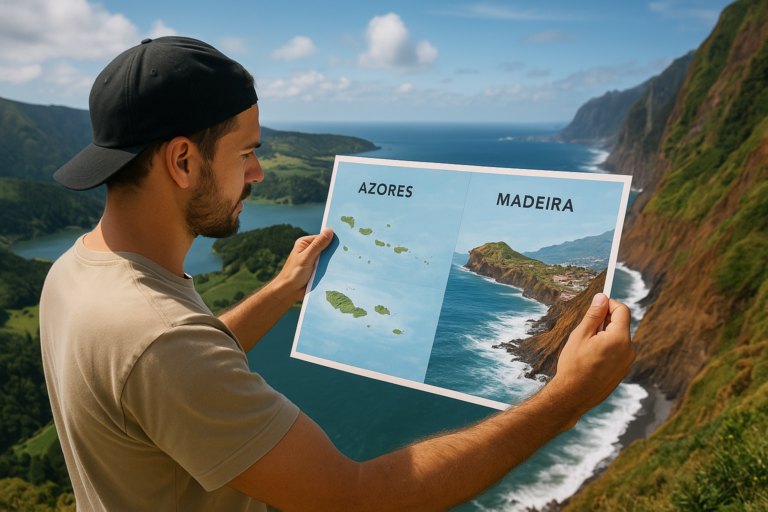
Madeira earns its nickname as the Island of Eternal Spring. The climate is mild and relatively stable year-round, which makes it one of the best European island destinations for winter travel. Spring and autumn are lovely for hiking. Summer is warm but can get busy. If you’re planning a trip between November and February and weighing up Azores vs Madeira, Madeira is the stronger choice for weather reliability during those months.
Cost and Practicalities: An Honest Comparison
Let’s talk money, because it matters. Madeira is generally considered more upscale and more expensive than the Azores. That doesn’t mean Madeira is unaffordable — it’s still a Portuguese destination with good value compared to many Western European cities — but you’ll likely spend more on accommodation and dining in Funchal than you would in Ponta Delgada on São Miguel. The Azores, by contrast, has a slightly more budget-friendly feel, with a wider range of guesthouses, rural stays, and self-catering options across its islands.
Both archipelagos are accessible by direct flights from Lisbon and from several European cities. Madeira has one main airport on the main island, while the Azores has airports on multiple islands, which means island-hopping is a real and very rewarding option if you have the time. Inter-island flights in the Azores are relatively affordable and add a whole extra dimension to your trip.
Accommodation-wise, both islands offer everything from budget hostels and guesthouses to boutique hotels and rural quintas (farmhouses). The Azores tends to have more rural and nature-based stays, while Madeira has a stronger urban hotel scene centered on Funchal. For a deeper comparison of costs and living experiences across both islands, the insights shared by expats who’ve lived in both places — weighing up public transportation, food costs, and daily life — are genuinely useful for understanding what your money actually gets you in each location. You can find one such detailed comparison from people who’ve experienced both islands firsthand at Lotus Eaters Travel’s Madeira vs Azores guide.
Which Type of Traveler Suits Each Island?
This is the real question, isn’t it? The Azores vs Madeira debate isn’t about which island is better — it’s about which one is better for you.
Choose the Azores if you…
- Want to feel genuinely off the beaten path
- Love volcanic landscapes, crater lakes, and geothermal weirdness
- Are into whale watching, diving, or serious marine wildlife encounters
- Want to island-hop and explore multiple distinct environments in one trip
- Are traveling on a tighter budget and want to stretch your money further
- Prefer fewer crowds and a more local, unhurried atmosphere
- Don’t mind unpredictable weather and see it as part of the adventure
Choose Madeira if you…
- Want world-class hiking on well-maintained, accessible trails
- Are visiting in winter and want reliable mild weather
- Love the combination of city life and nature in the same destination
- Want a more developed food and dining scene
- Are traveling with someone who prefers comfort and infrastructure
- Want dramatic scenery without the need to island-hop
- Are happy to spend a bit more for a polished experience
Can You Visit Both?
Yes — and if you have the time, you absolutely should. The two archipelagos complement each other in a way that makes a combined trip feel genuinely satisfying rather than rushed. A week in the Azores followed by a week in Madeira (or vice versa) gives you two completely different island experiences within a single Portuguese adventure. You’ll go from volcanic craters and whale watching to mountain ridges and levada walks, and the contrast makes both places feel even more vivid.
The logistics are manageable. You can fly between the islands via Lisbon, and flights are frequent enough that you don’t need to plan too far in advance. Some travelers have found that combining both islands with a few days on the Portuguese mainland makes for a well-rounded trip — though that does require more time and a bit more planning. The TripAdvisor forum on Azores vs Madeira vs mainland Portugal has some useful firsthand advice from travelers who’ve done exactly that combination.
The Bottom Line
Both islands are extraordinary, and neither one is a compromise. The Azores will give you a rawer, wilder, more remote kind of adventure — the kind where you feel like you’ve genuinely discovered something. Madeira will give you drama, accessibility, and a hiking experience that rivals anything in Europe, wrapped in a destination that’s easy to love from the moment you arrive. When you’re weighing up Azores vs Madeira, the honest answer is that you can’t go wrong. The real question is just which story you want to tell when you get home. Pick the one that already has you excited — and go collect it.
This article was produced with AI assistance and reviewed editorially.


Japan for First-Timers: A 2-Week Itinerary Beyond the Guidebook

The Solo Travel Confidence Guide: How to Travel Alone Without the Anxiety


